A CONTROLLED TRANSITION. NOT JUST A DOORWAY.
Entering a cleanroom is not simply walking through a door in protective clothing.
It is a controlled transition between environments with different contamination-control requirements.
This lesson follows four connected stages: BEFORE ENTRY → DURING TRANSITION → INSIDE THE CLEANROOM → WHEN LEAVING.
For candidates, understanding these stages helps explain real experience and prepare for site training. For employers and recruitment partners, it provides a framework for discussing procedure awareness, boundaries and responses to uncertainty.
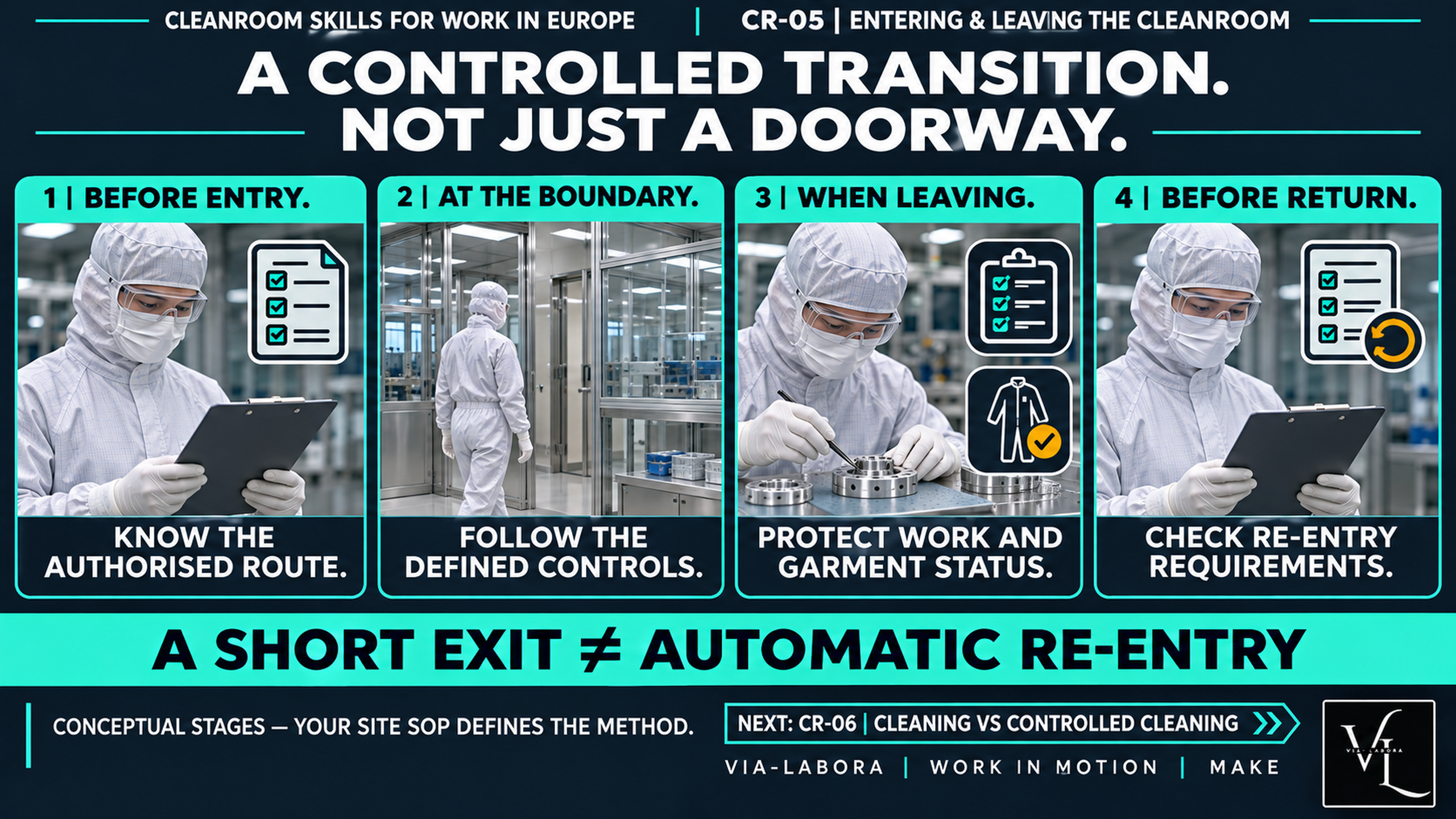
These four stages explain the purpose of controlled personnel transitions. They are not a universal gowning sequence, architectural layout or door-operating procedure. Your site instruction defines the method.
Four stages
BEFORE ENTRY
Confirm your authorisation, training, current instruction, approved preparation and restrictions on items.
DURING TRANSITION
Use the designated route and applicable controls. Follow local rules for boundaries, doors and permitted contacts. Airlocks and interlocks depend on the facility design.
INSIDE THE CLEANROOM
Maintain controlled behaviour and contact awareness. Correct gowning alone does not establish that every action is acceptable. Follow the task instruction and preserve component status.
WHEN LEAVING
Follow the requirements for unfinished work, exit routes and garment handling. Check the conditions for any later return. Exit is not necessarily entry in reverse.
CR-05 focuses on personnel entry, exit and return. It introduces the distinction between personnel access and item transfer, but detailed material flow is developed in CR-13. The fact that a person may use an entrance does not establish permission to bring an item through it.
SITUATION FROM WORK
An operator leaves the controlled area briefly to collect information. On returning, the operator says:
“I was only outside for a minute. I can go straight back.”
But elapsed time alone does not establish whether the person still meets the entry requirements.
Where did they go? What did their gloves or garments contact? Which route applies? What does the site require before re-entry?
A short exit can still change the conditions relevant to contamination control.
Caption:
“This board explains the purpose of entry, exit and re-entry controls. It is not a universal route, gowning sequence or instruction for operating doors.”
WHO IS THIS FOR?
- Candidates preparing for their first controlled-environment role.
- Experienced operators joining a different facility.
- Team leaders discussing interruptions, access and return to work.
- Employers and recruitment partners assessing practical understanding.
WHAT WILL YOU GAIN?
For candidates:
Understand why access involves more than a badge or cleanroom suit. Prepare useful questions for site training and describe previous experience accurately.
For employers and partners:
Distinguish familiarity with one facility from an understanding of controlled transitions. Identify what requires local training and practical assessment.
For teams:
Clarify how normal entry, planned exit, interruptions and re-entry are managed.
LEARNING OBJECTIVES
After this lesson, you should be able to:
- Explain the purpose of controlled entry and exit.
- Distinguish access permission from readiness to perform a task.
- Identify how crossing a boundary can affect contact history and item status.
- Explain why re-entry must follow defined requirements.
- Recognise which details depend on the site procedure.
- Respond appropriately when the route or status is unclear.
TECHNICAL FOUNDATION
WHY CONTROL THE TRANSITION?
Areas may have different cleanliness requirements, permitted activities and rules for garments or items.
A person moving between them can carry contamination on clothing, footwear, gloves or objects. Door opening and movement can also affect the separation between areas.
The controls must suit the facility and process.
They may involve defined routes, changing areas, garment arrangements, access controls or door systems. Not every facility uses the same combination.
A badge granting access does not prove completion of the required preparation.
WHAT IS A BOUNDARY?
A boundary is a defined separation between areas with different requirements.
It may be represented by a doorway, changing area, bench, floor marking or another site arrangement.
Its appearance does not tell you all its rules. Learn what the boundary means locally.
A floor line does not remove contamination. A closed door does not establish garment status. Each control has a particular purpose.
DOORS AND TRANSITION AREAS
Some facilities use airlocks or interlocked doors to manage transitions.
An airlock is an intermediate space with controlled access between areas. An interlock can restrict door opening according to the installation’s design.
These systems do not automatically establish that garments, items or people meet every requirement.
Follow the normal door-use instructions. Do not hold doors open, bypass controls or copy another person’s access unless the procedure explicitly permits the action.
No universal waiting time, pressure difference, airflow direction or air-shower requirement is prescribed here.
NORMAL EXIT IS ALSO A CONTROLLED ACTIVITY
A planned exit can require attention to unfinished work, exposed components, task records, garments and items.
Follow the relevant instructions before leaving a task and while removing or storing garments.
Do not assume exit is simply the entry procedure reversed. Removal, storage, disposal and subsequent reuse may have different requirements.
RE-ENTRY IS A NEW REQUIREMENT CHECK
An earlier successful entry does not automatically establish readiness to return.
Requirements may depend on the route taken, garment condition, contacts, activities outside and local rules.
Do not invent a “short absence” exception or assume that garments may always be reused.
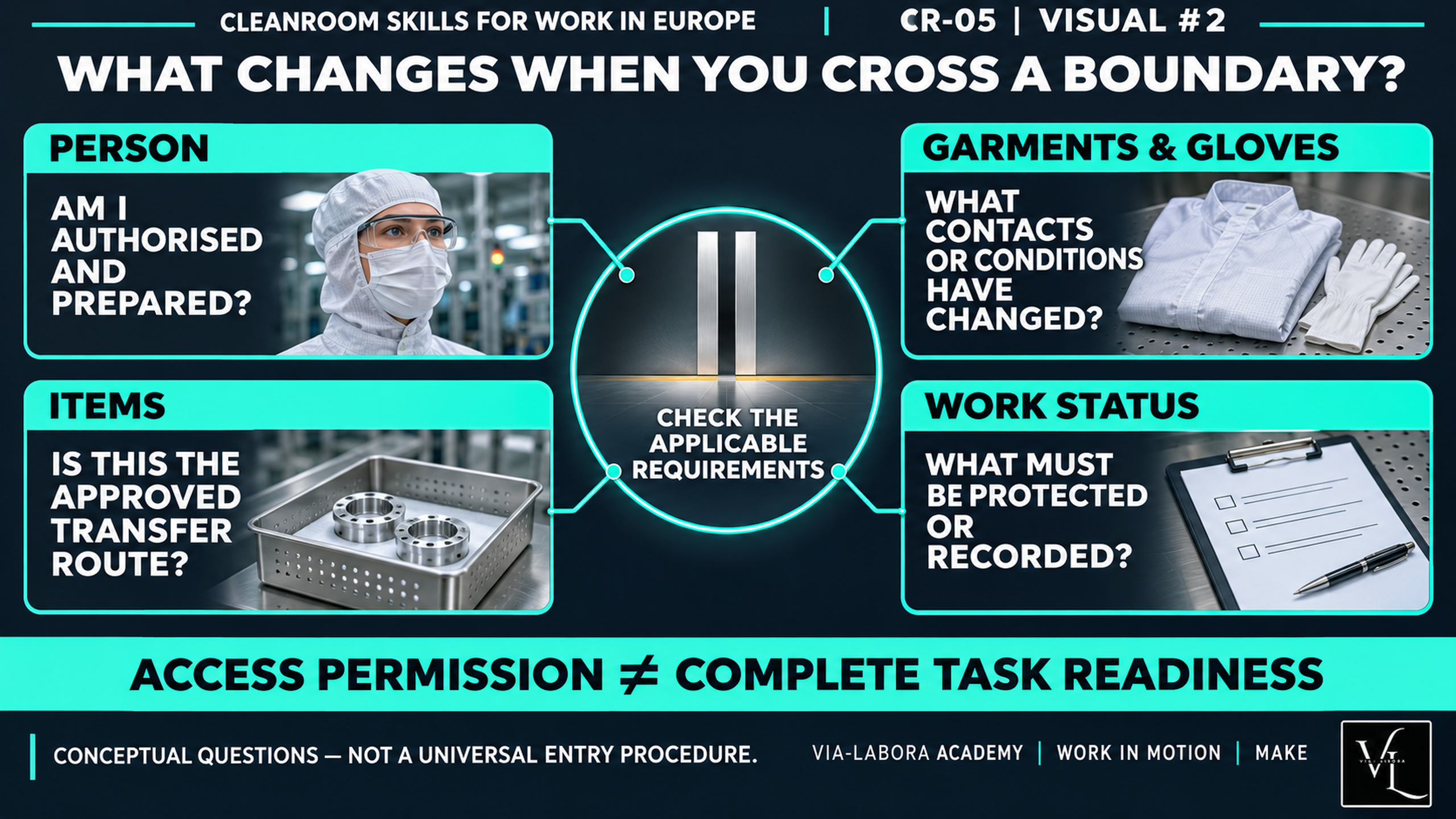
Caption:
“The diagram identifies questions that can arise at a boundary. It does not show an actual floor plan, measured airflow or a mandatory sequence.”
PERSONNEL AND MATERIAL MOVEMENT
An approved personnel route is not automatically an approved route for tools, packaging or components.
Do not carry an item through an entrance merely because you can pass through it.
Detailed material flow belongs in CR-13. Here, the important distinction is that people and items may have separate transfer requirements.
EMERGENCY EXIT
Routine contamination-control instructions must not delay an emergency response.
Follow the site’s emergency training and designated escape arrangements. Do not apply normal changing or waiting steps to an evacuation unless the emergency procedure explicitly requires them.
Emergency arrangements are site-specific.
TERMINOLOGY — EN / PL
Controlled transition — kontrolowane przejście między obszarami.
Access authorisation — upoważnienie do dostępu.
Entry requirements — wymagania wejścia.
Re-entry — ponowne wejście.
Boundary — granica między obszarami.
Airlock — śluza.
Door interlock — system blokady wzajemnej drzwi.
Doffing / de-gowning — zdejmowanie odzieży.
Contact history — historia kontaktu.
Task status — status wykonania zadania.
Escalation — przekazanie sprawy zgodnie z ustaloną ścieżką.
PROCESS EXPLANATION
The following questions form a learning framework, not an operating sequence.
BEFORE ENTRY:
Am I authorised and trained?
Which route and current instruction apply?
What preparation and item restrictions apply?
AT THE TRANSITION:
What do the boundaries and door indications mean?
Which contacts are permitted?
How is completion of preparation established?
BEFORE A PLANNED EXIT:
What must happen to the work and its status?
Which route and garment-removal requirements apply?
BEFORE RETURN:
What happened outside?
Which re-entry requirements now apply?
Who resolves uncertainty?
Use the approved procedure to answer these questions.
PRACTICAL SCENARIO
A planned exit also raises a question about return. The length of an absence alone does not establish that re-entry requirements remain satisfied. The following scenario applies the boundary-control principles to a short interruption.
An operator preparing precision components leaves to retrieve information.
During the interruption, the operator handles a surface outside the controlled area. On returning, the operator is unsure what to do with the gloves and whether the same garments can be reused.
The correct learning outcome is not “always change everything” or “always disinfect”.
It is:
Recognise the uncertainty, avoid further uncontrolled contact and follow the defined re-entry or clarification process.
If the work’s status also became unclear, resolve that separately through the applicable task procedure.
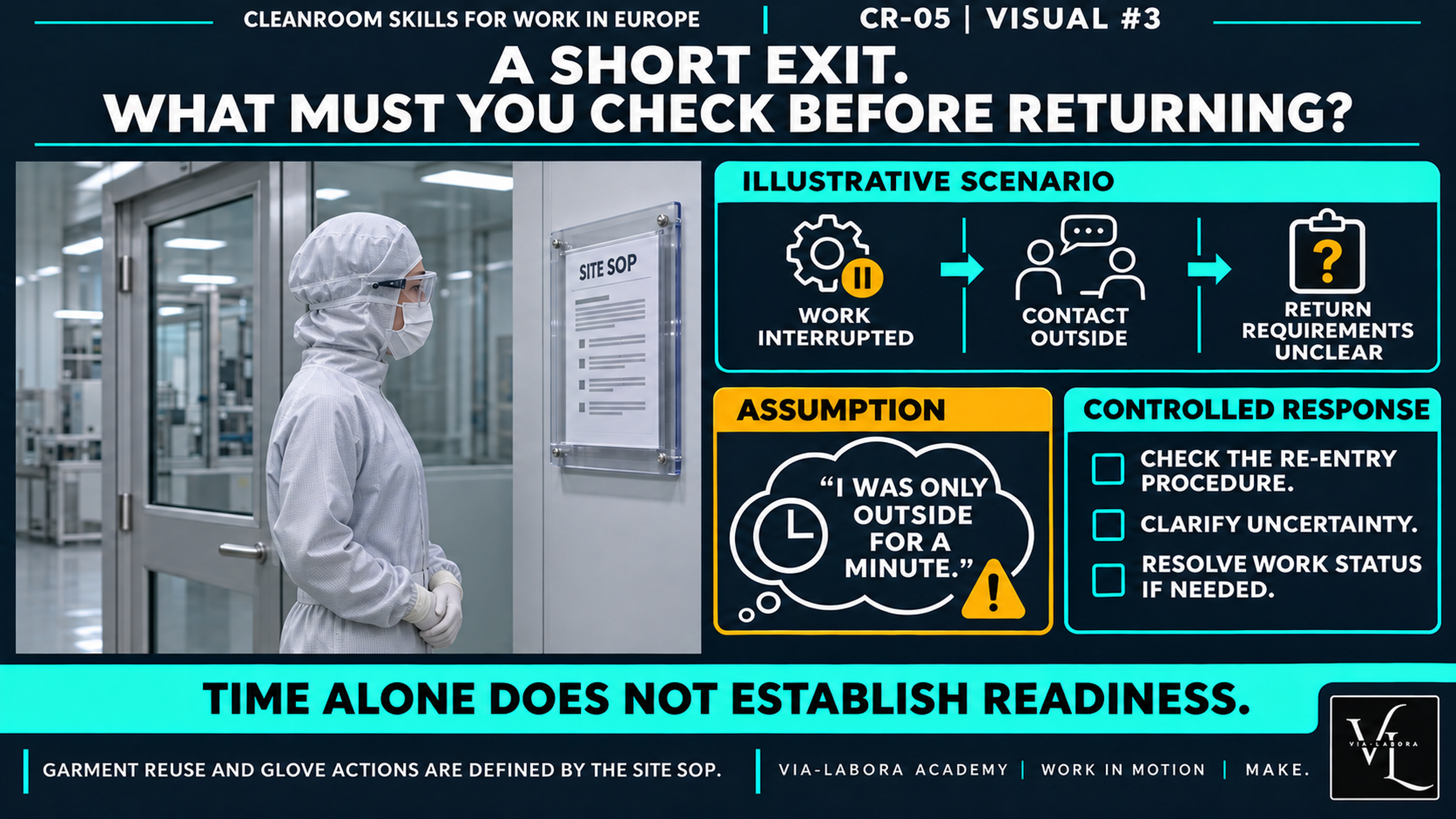
Caption:
“This scenario identifies information needed before return. It does not determine garment reuse, glove treatment or product acceptance.”
COMMON MISTAKES AND RISKS
“My badge works, so I am ready.”
Access permission and completion of preparation are different matters.
“I left for only a minute.”
Time alone does not establish suitability for return.
“I will follow the person in front.”
Their authorisation, task or required route may differ.
“The door system controls everything.”
Door controls do not replace garment and item requirements.
“I can carry this tool through my entrance.”
The tool may require a separate approved transfer method.
“I can remove garments in reverse order.”
Use the specified removal method.
WHAT DEPENDS ON THE SITE SOP?
- Access permissions and training.
- Entry and exit routes.
- Garment selection, sequence and checks.
- Door operation and any waiting conditions.
- Personal-item and device restrictions.
- Garment storage, reuse and disposal.
- Re-entry after breaks or unexpected exits.
- Work-status and handover requirements.
- Reporting, alarms and emergency arrangements.
Do not transfer these details automatically from another employer.
PRACTICAL EXERCISE
Scenario:
A colleague asks you to hold a controlled door open while they collect an item. You do not know whether the action is permitted.
Answer:
- What is known?
- What remains unknown?
- What should you avoid assuming?
- Where should the correct response come from?
Show suggested response
The proposed action is known; its permission and effect are not. Do not assume that convenience makes it acceptable or that every door has identical rules. Follow the door-use procedure or seek clarification. Do not improvise a bypass.
KNOWLEDGE CHECK
1. Does a working access badge prove readiness to enter?
Show answer
No. Required preparation and training must also be satisfied.
2. Does a short absence automatically allow direct return?
Show answer
No. Follow the re-entry requirements.
3. Is an airlock a substitute for gowning and item controls?
Show answer
No. It serves part of the transition-control system.
4. Can personnel and tools always use the same route?
Show answer
No. Their approved transfer requirements may differ.
5. Is exit always entry in reverse?
Show answer
No. Follow the defined removal and exit method.
6. What should happen when status is unclear?
Show answer
Use the applicable clarification process before continuing affected activity.
7. Should routine cleanliness steps delay emergency evacuation?
Show answer
No. Follow the site’s emergency procedure.
USE IT IN A TECHNICAL INTERVIEW
Describe the requirements you actually followed.
Example:
“I used the authorised personnel route, followed the site’s entry and exit instructions and checked the requirements before returning after an interruption.”
Be prepared to explain:
- How you learned the route.
- What you did with work before a planned exit.
- How re-entry was handled.
- Who resolved uncertainty.
Do not invent experience or present one site’s sequence as universal.
USE IT WITH YOUR TEAM
The sign at a boundary appears inconsistent with the entry instruction. Before proceeding, how should the uncertainty be resolved? Who is authorised to clarify it, and what recording is required under the local system?
Safely pause the affected activity in accordance with local instructions and use the defined clarification or escalation route. This is not a universal instruction to stop machinery abruptly.
Discuss:
- Are routes and boundaries understood?
- Do people know the difference between access permission and task readiness?
- Are break and re-entry instructions clear?
- Is work status preserved during interruptions?
- Are item-transfer routes understood?
- Can staff distinguish routine exit from emergency escape?
Raise unclear or impractical arrangements through the approved improvement route.
KEY TAKEAWAYS
- Entry and exit are controlled transitions.
- Access permission does not establish every readiness requirement.
- Boundaries have site-specific meanings.
- A short absence does not automatically permit direct return.
- People and items may need different transfer arrangements.
- Exit is not necessarily entry in reverse.
- Follow local instructions and emergency training.
Entry, Exit & Re-entry — Trainer Discussion Sheet
A two-page EN/PL learning aid to complete with your trainer using current site instructions. Record the authorised route, preparation, permitted items, planned exit, re-entry and clarification contacts.
Trainer discussion sheet
Learning aid only. Complete with your trainer. Not an entry permit, universal checklist or substitute for the site procedure.
FOR CANDIDATES AND EMPLOYERS
CANDIDATES
Have practical controlled-environment experience?
Tell VIA-LABORA about your actual tasks, training, access arrangements and responsibilities. Explain how you handled interruptions and return to work.
Contact:
technicals@via-labora.com
WhatsApp +48 504 016 136
Ask about current opportunities or the Technical Talent Pool. Availability and role requirements vary.
EMPLOYERS AND PARTNERS
Look beyond “has worked in a cleanroom”.
Discuss role-specific screening with VIA-LABORA, including understanding of boundaries, local procedures, work status and escalation.
Interview reasoning supports assessment; site training and practical authorisation remain necessary.
PREVIOUS / NEXT EPISODE
Next: CR-06 — Cleaning vs Controlled Cleaning
Removing visible dirt is not the same as meeting a defined cleaning requirement. CR-06 explains why materials, methods and acceptance criteria matter.
References and scope
This introductory lesson explains operating principles. It does not reproduce the full standard or define a universal site procedure.