People are part of the contamination-control system.
A cleanroom can have controlled air, suitable equipment and approved materials. Its performance still depends on what people do inside it.
People can generate particles, carry contamination between surfaces and change the conditions around exposed work through their movements and activities.
They are also an essential part of the solution: following instructions, recognising uncertainty, protecting product status and reporting unexpected events.
The main message of this lesson is:
CORRECT GOWNING ≠ AUTOMATICALLY CORRECT BEHAVIOUR.
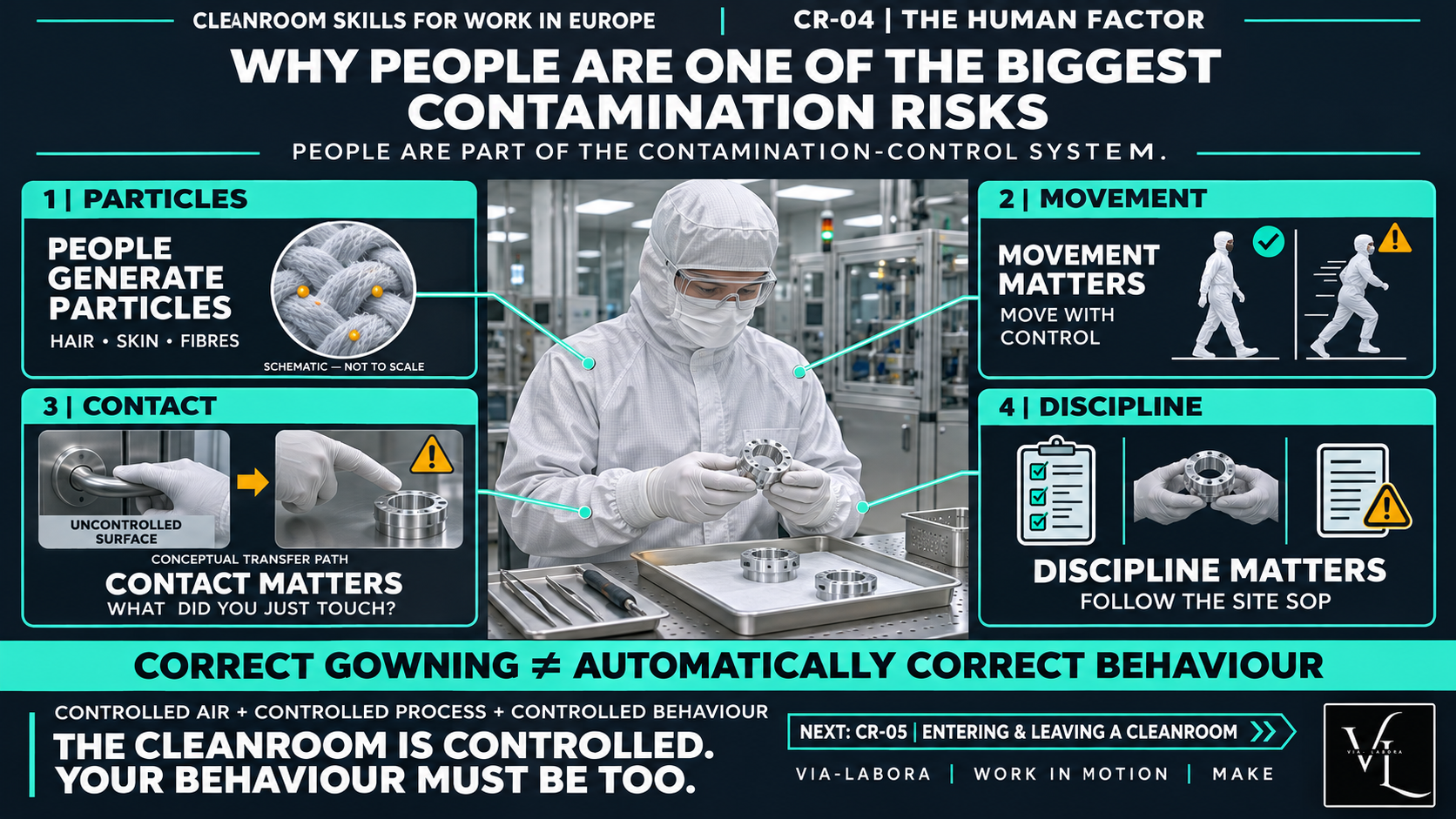
View visual 1 full size (opens a new tab) ↗
- Explain human contamination sources and pathways.
- Recognise how movement, contact history and interruptions can affect controlled work.
- Report facts and follow the site process when uncertain.
WHY THIS MATTERS AT WORK
An operator may be correctly gowned and still introduce a contamination pathway.
A glove touches an uncontrolled surface before approaching a precision component. A sleeve passes across exposed work. A familiar task is rushed after an interruption.
None of these examples automatically proves that a product has been contaminated. Each creates a question that must be evaluated against the process requirements.
Understanding the human factor helps you notice these situations before they become repeated habits.
It also helps you recognise when the working system needs improvement. An awkward layout, unclear instruction or missing approved tool should be raised—not solved through an improvised shortcut.
LEARNING OBJECTIVES
After this lesson, you should be able to:
- Explain how people can generate and transfer contamination.
- Distinguish airborne transfer from contact transfer.
- Explain why movement and work organisation matter.
- Assess contact history without assuming a measured contamination event.
- Recognise how interruptions, habits and time pressure can affect execution.
- Describe an appropriate response to uncertainty or a possible deviation.
PREREQUISITES / CONNECTION TO PREVIOUS LESSONS
CR-01 introduced contamination-control logic:
LOOKS CLEAN ≠ VERIFIED CLEAN.
CR-02 separated environmental classification from product acceptance and operator competence.
CR-03 explained why garment selection, gowning technique and behaviour must work together.
CR-04 now focuses on what happens as people perform work.
Detailed entry and exit methods remain in CR-05. Cleaning, component handling and assembly techniques are developed in their dedicated lessons.
CORE THEORY
1. PARTICLES — PEOPLE CAN BE SOURCES AND CARRIERS
People naturally shed skin material and hair. Clothing and garments can also release fibres or other particles.
People can additionally carry contamination acquired from materials, equipment or surfaces.
These are different mechanisms:
GENERATION:
Contamination is released during an activity.
TRANSFER:
Existing contamination moves from one location to another.
Someone can appear clean and still be involved in either mechanism.
Suitable garments help limit contamination associated with the wearer. They do not eliminate every possible release or contact pathway.
The amount and significance depend on the activity, garment system, environment and sensitive product. There is no universal particle-generation rate for every operator or movement.
2. MOVEMENT — ACTIVITY CHANGES THE CONDITIONS AROUND WORK
Movement can contribute to particle release and disturb local air movement. It can also bring garments, hands or objects closer to exposed surfaces.
The practical objective is controlled, purposeful movement appropriate to the task.
This does not mean moving as slowly as possible. It means avoiding unnecessary activity and following the method taught for the operation.
Examples of questions to consider:
- Does this reach bring a sleeve across sensitive work?
- Am I moving an item through an area where it does not belong?
- Does the layout require repeated unnecessary movement?
- Am I following the defined route and working arrangement?
Do not infer airflow direction from the photographs or diagram arrows. Actual airflow behaviour is a facility-specific matter.
No universal walking speed, hand speed or movement limit is prescribed in this lesson.
3. CONTACT — CONTAMINATION CAN TRAVEL THROUGH A CHAIN
A transfer pathway may contain several contacts:
Uncontrolled surface → glove → tool → component.
Not every surface carries the same contamination, and not every contact produces the same transfer.
The important reasoning questions are:
What was touched?
What happened next?
Which feature may be sensitive?
What does the approved procedure require?
A visually unchanged glove does not prove that its condition is unchanged.
Likewise, an uncertain contact does not automatically prove that contamination reached the product.
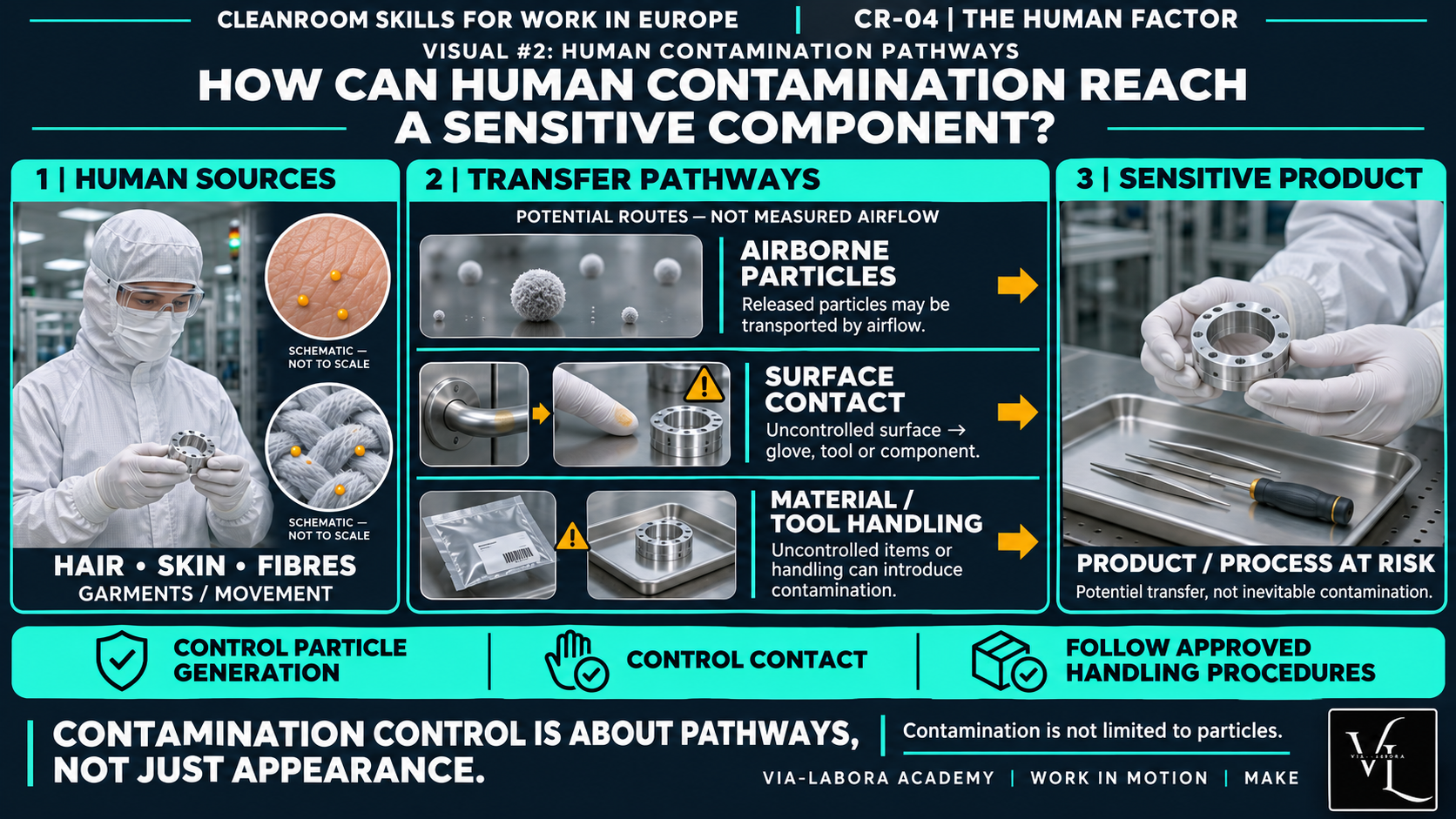
View visual 2 full size (opens a new tab) ↗
READING THE PATHWAY DIAGRAM
The diagram connects three parts:
SOURCE:
People, their clothing or contamination carried through their activities.
PATHWAY:
Airborne movement, surface contact or handling involving materials and tools.
SENSITIVE PRODUCT:
The feature or process that may be affected.
“Material/tool handling” can involve both contact transfer and particle release. It is an activity, not a completely separate physical mechanism.
The diagram helps identify where control is needed. It does not determine product acceptance.
4. DISCIPLINE — CONSISTENT EXECUTION, NOT BLAME
Discipline means applying the approved method consistently, including during routine work.
It includes:
- Keeping track of task and component status.
- Following the current instruction.
- Recognising the limits of your authorisation.
- Reporting mistakes or uncertainty accurately.
- Avoiding undocumented shortcuts.
Human-factor problems are not always caused by a lack of care.
Distractions, fatigue, confusing instructions, poor layout, time pressure and unclear handovers can make mistakes more likely.
A reliable system supports people with suitable training, workable instructions, appropriate equipment and a clear route for questions.
If a task repeatedly requires an awkward workaround, raise the problem. Do not make an unofficial method part of the routine.
5. CONTACT HISTORY MATTERS
The third visual compares two patterns:
CONTROLLED CONTACT:
The work follows approved preparation and handling requirements.
UNCONTROLLED CONTACT:
An event introduces uncertainty into that chain.
The key distinction is the known process and contact history—not the visual appearance of the gloves or the operator.
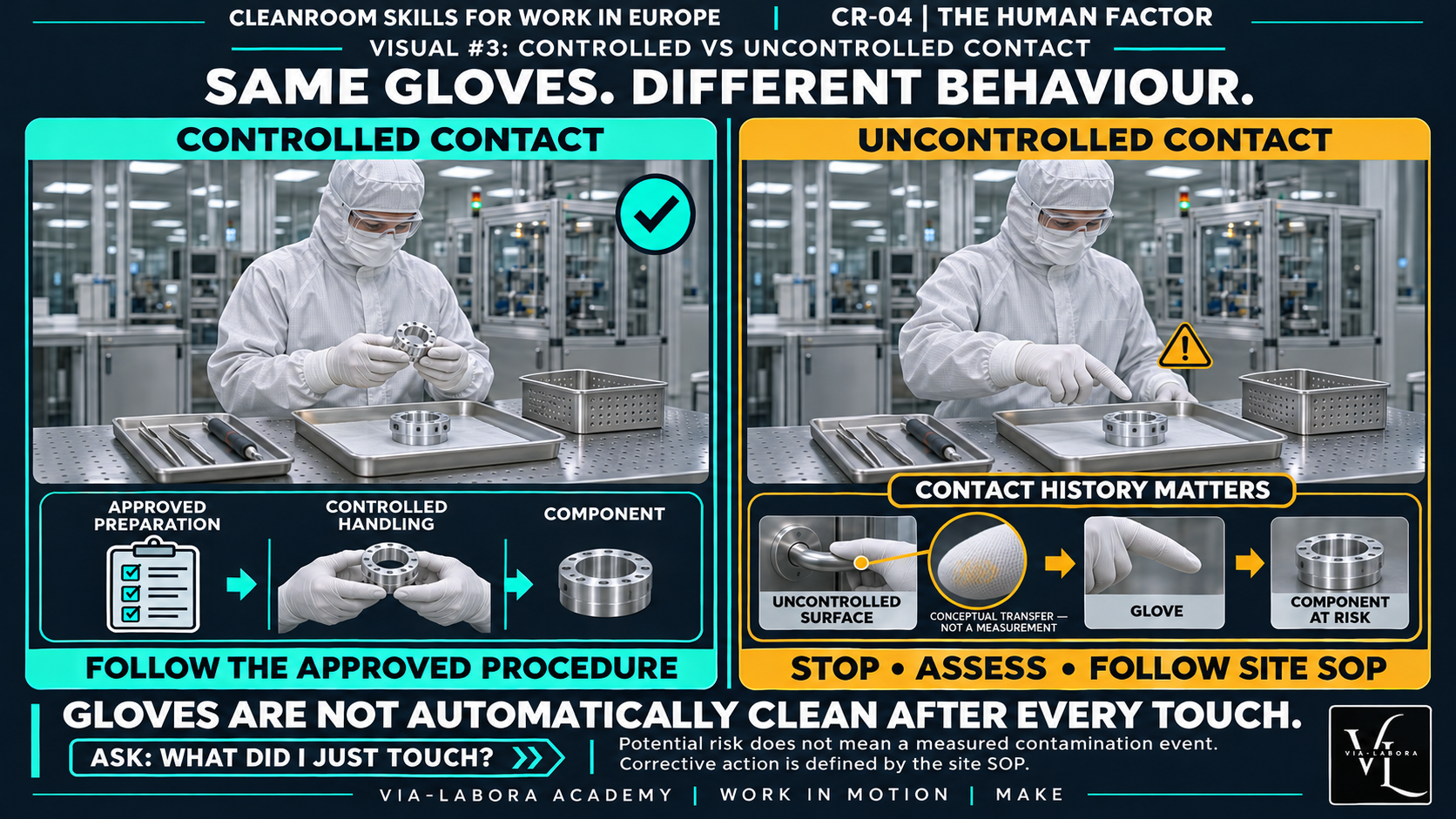
View visual 3 full size (opens a new tab) ↗
WHAT DOES “STOP • ASSESS • FOLLOW SITE SOP” MEAN?
It means avoid continuing the affected activity without considering the event.
Any pause must be made safely and in line with local instructions. It is not a universal instruction to stop machinery abruptly.
Assess within your training and authority. You may need to report what happened so that an authorised person can assess the consequences.
Follow the prescribed response. Do not invent a glove treatment, cleaning method or product disposition.
6. CONTAMINATION AWARENESS IS NOT THE SAME AS INSPECTION
Contamination awareness helps identify risks during work.
Inspection evaluates an item against specified criteria using an appropriate method.
An operator may identify a possible contact event without being able to determine whether the component meets its acceptance criteria.
Conversely, a component passing a particular visual check does not establish that every contamination requirement has been assessed.
Detailed inspection methods belong in CR-09.
7. GOOD DOCUMENTATION PRESERVES WHAT HAPPENED
If an event requires reporting, describe observations accurately.
Useful information may include the affected item, operation, known contact and subsequent actions, as required by the site.
Separate fact from inference:
FACT:
“My glove touched the handle before I approached the component.”
UNCONFIRMED:
“The component is contaminated.”
Do not convert an assumption into a recorded test result.
Documentation and traceability are developed in CR-11.
TECHNICAL TERMINOLOGY
Human factor:
The influence of human actions, capabilities and working conditions on process performance.
Particle generation:
Release of particles from a source during an activity.
Airborne transfer:
Transport of contamination through the air.
Contact transfer:
Movement of contamination through surface contact.
Contact history:
The relevant sequence of contacts involving an item or surface.
Sensitive feature:
A product feature whose condition matters to defined requirements.
Deviation:
A departure from a specified requirement, handled according to the applicable system.
Situational awareness:
Maintaining an understanding of the task, surroundings and relevant changes.
Handover:
Transfer of information and responsibility between people or stages.
Product disposition:
An authorised decision about what happens to an affected item.
STEP-BY-STEP EXPLANATION
HOW TO REASON ABOUT A HUMAN-FACTOR EVENT
This framework supports learning. It is not a universal incident-response procedure.
1 — IDENTIFY THE EVENT
Describe what actually happened.
Avoid jumping immediately to a contamination conclusion.
2 — IDENTIFY THE POSSIBLE PATHWAY
Could contamination move through air, contact or a chain of handling activities?
3 — IDENTIFY THE SENSITIVE WORK
Which component, tool, surface or operation could be affected?
4 — IDENTIFY THE MISSING INFORMATION
What is known about the contact, status, requirements and subsequent activity?
5 — FOLLOW THE LOCAL RESPONSE
Make any pause safely. Use the reporting or clarification route defined for your role.
6 — PRESERVE STATUS AND ACCURATE INFORMATION
Follow local instructions for affected items and records. Do not independently clean, release or reject them without authority.
REALISTIC HIGH-TECH PRODUCTION EXAMPLES
These examples illustrate reasoning, not task instructions.
EXAMPLE 1 — THE DOOR HANDLE
An operator touches a handle and then prepares to handle a precision component. The handle’s permitted use and the next-step requirements are unclear.
Reasoning:
A possible contact pathway exists. Establish what the procedure requires before continuing the affected handling. If contact with the component already occurred, report the event as required.
Do not assume every handle in every facility has the same status.
EXAMPLE 2 — THE REPEATED REACH
A tool is stored where the operator must repeatedly reach across exposed work.
Reasoning:
The arrangement may create avoidable movement or contact risk. Raise the layout issue through the approved route. Do not move approved storage or redesign the workstation without authorisation.
EXAMPLE 3 — THE INTERRUPTION
An operator is interrupted while preparing several similar components. On returning, the operator is unsure which items completed the preparation step.
Reasoning:
This is a status-control problem even if nothing looks dirty. Re-establish status through the approved process rather than relying on memory or appearance.
EXAMPLE 4 — THE GLOVE ADJUSTMENT
An operator adjusts a face covering and prepares to resume assembly.
Reasoning:
Consider the contact history and follow the required response. Do not assume the glove remains suitable or that one generic treatment will resolve the event.
EXAMPLE 5 — THE HANDOVER
A colleague takes over a task but receives incomplete information about component status.
Reasoning:
A handover can affect contamination control through decisions and handling, even without directly generating particles. Clarify status before proceeding.
COMMON MISTAKES
“Correct gowning means my behaviour is automatically controlled.”
Garments support control; they do not replace it.
“The ventilation will remove anything I introduce.”
Air controls do not resolve every surface-contact or residue risk.
“If I move extremely slowly, I am following good practice.”
Use the task’s approved method. Movement speed alone does not establish control.
“The glove looks unchanged, so the contact did not matter.”
Appearance does not establish contact history.
“A potential risk proves the part is contaminated.”
Risk identification and confirmed contamination are different conclusions.
“I should fix it quickly before anyone notices.”
Use the approved response and report accurately.
“Human factor means blaming the operator.”
Working conditions, layout, training and instructions also matter.
OPERATOR BEHAVIOUR / REAL JOB CONTEXT
Reliable controlled-environment work combines practical skill with awareness of process status.
An experienced operator should be able to explain:
- Which surfaces and contacts mattered in their work.
- How they managed interruptions and handovers.
- Which situations required clarification.
- How they reported events.
- Which decisions required another authorised person.
This is more informative than simply stating that they wore cleanroom garments.
A useful experience statement is:
“I followed controlled handling instructions, maintained awareness of contact history and component status, and used the defined reporting route when an event or interruption created uncertainty.”
Only claim activities you actually performed.
TRY IT YOURSELF
SCENARIO 1 — THE HANDLE AND THE PART
A glove touches a surface whose status you do not know. The operator then approaches a sensitive component.
Questions:
What is known?
What is the possible pathway?
What should not be assumed?
Show suggested answer
The contact is known. A surface-to-glove-to-component pathway is possible. Do not assume either confirmed contamination or continued suitability. Follow the applicable instruction and reporting route.
SCENARIO 2 — THE LOST PLACE
An interruption leaves you unsure which component completed preparation.
Question:
Can you identify the completed part by choosing the one that looks cleaner?
Show suggested answer
No. Appearance cannot reliably reconstruct process status. Use the approved method for resolving uncertainty.
SCENARIO 3 — THE AWKWARD WORKSTATION
The approved arrangement repeatedly forces an uncomfortable reach near exposed work.
Question:
Should you create a faster unofficial arrangement?
Show suggested answer
Raise the problem and seek an approved improvement. Do not silently replace the working method.
SCENARIO 4 — FACT OR CONCLUSION?
You observed uncontrolled contact, but no test has been performed.
Question:
Which statement is more accurate?
A. “The product failed contamination testing.”
B. “An uncontrolled contact occurred; product impact has not yet been determined.”
Show suggested answer
B. It separates the observed event from an unconfirmed outcome.
KNOWLEDGE CHECK
1. How can people influence contamination control?
Show answer and explanation
Through particle generation, transfer, movement and decisions during work.
Explanation:
People are both possible sources and active contributors to control.
2. Why can gloves transfer contamination?
Show answer and explanation
Their surfaces can carry material acquired through earlier contacts.
Explanation:
Wearing gloves does not erase contact history.
3. Do the arrows in Visual #2 represent measured airflow?
Show answer and explanation
No.
Explanation:
They show conceptual pathways.
4. Does a possible pathway establish that a product is contaminated?
Show answer and explanation
No.
Explanation:
The event must be assessed against requirements and available evidence.
5. Why are interruptions relevant?
Show answer and explanation
They can disrupt task status and increase reliance on memory.
Explanation:
Uncertainty can affect subsequent handling and decisions.
6. What should happen after a repeated layout problem is identified?
Show answer and explanation
Raise it through the approved improvement or support route.
Explanation:
Reliable behaviour needs a workable system as well as trained people.
KEY TAKEAWAYS
- People are part of the contamination-control system.
- Correct gowning does not automatically produce correct behaviour.
- Particle generation and contamination transfer are different mechanisms.
- Movement can influence release, transport and contact opportunities.
- Contact history and process status matter.
- Potential risk is not the same as a measured contamination event.
- Follow the site procedure and report facts accurately.
Human Factor Quick Guide
Source → Pathway → Sensitive Work → Required Response
Learning aid only. Not a universal response procedure. Potential risk is not proof of contamination.
References and scope
- ISO 14644-5:2025 — Cleanrooms and associated controlled environments — Part 5: Operations
- ASHRAE Handbook — Clean Spaces
- DuPont — Effective combination of personal and product protection in a cleanroom
These sources support the operational context, particle pathways and garment functions discussed here. No source is used to prescribe one universal working method.
This lesson does not define movement speeds, particle-generation rates, garment requirements, airflow arrangements or product-disposition rules.
Next in the series
Controlled behaviour starts before the workstation and continues when people move between areas. CR-05 explains the purpose of entry and exit controls while keeping the actual sequence tied to site procedures.