LOOKS CLEAN ≠ MEETS CLEANROOM REQUIREMENTS.
Situation from Work
A precision component looks spotless after wiping. Its operator does not know whether the wipe was approved, which agent was used or whether the required checks were completed. Can the component be used?
Appearance alone cannot answer that question. The component needs the status and evidence required for its intended operation. Equally, missing information does not prove that the component is contaminated: it means its acceptability is not established.
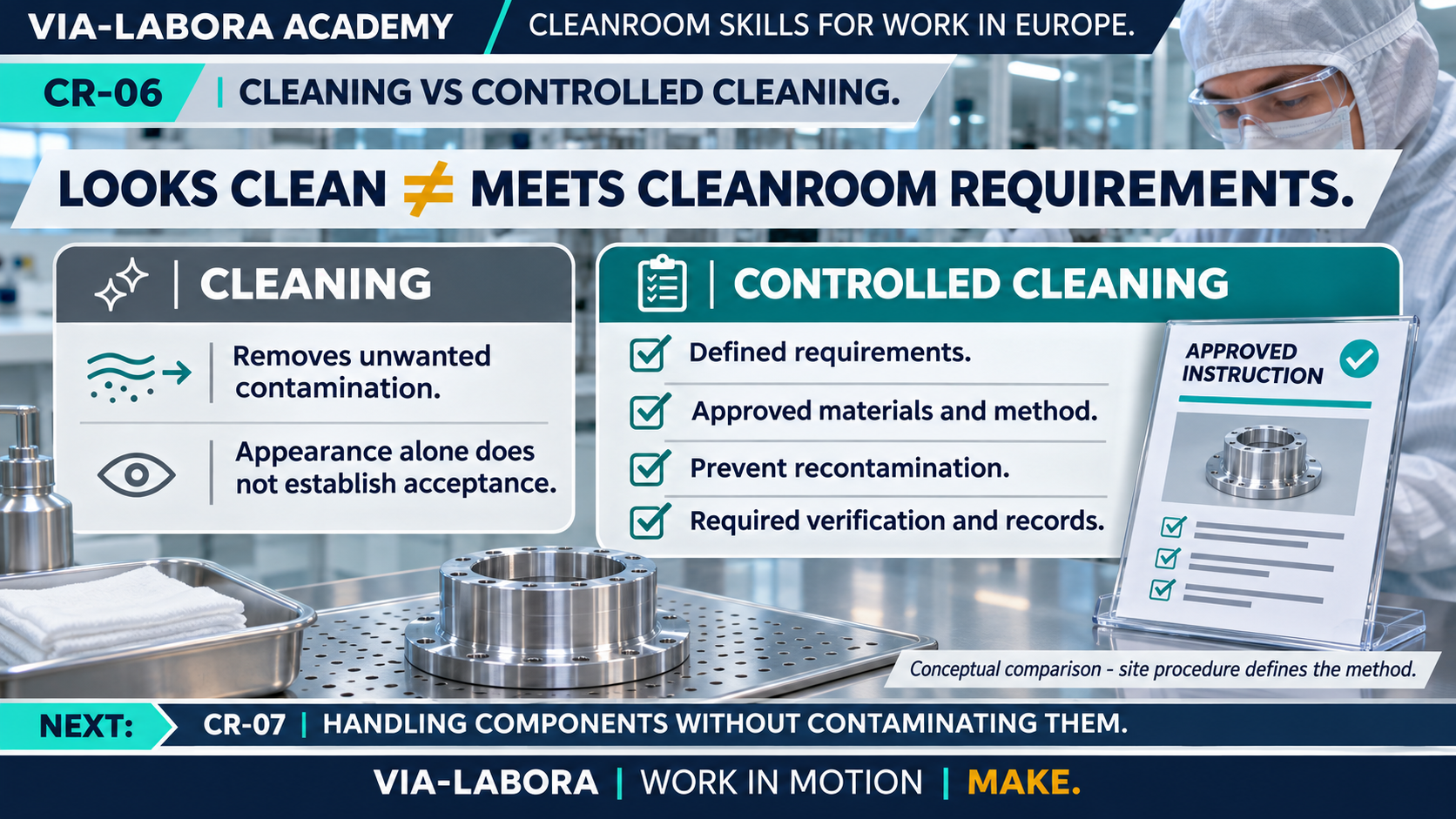
Caption: This comparison explains contamination removal and cleaning against defined requirements. It does not prescribe a cleaning method. Controlled cleaning can also occur outside a classified room; not all other cleaning is uncontrolled.
Who Is This For?
Candidates entering technical production; experienced operators who clean or handle sensitive items; leaders discussing training; employers and partners distinguishing general cleaning from relevant controlled-process experience.
What Will You Gain?
Candidates can identify relevant experience, recognise training needs and explain actual responsibilities. Employers can ask about the product, method, verification and authority instead of relying on the phrase “cleanroom cleaning”. Teams can identify where instructions or status information need clarification.
Learning Objectives
- Distinguish contamination removal from the controls used to meet a requirement.
- Identify relevant particles and residues without assuming their identity from appearance.
- Explain why approved materials and surface compatibility matter.
- Explain why protection after cleaning matters.
- Separate visual checks, verification, validation and acceptance.
- Recognise when clarification is required before acting.
Connection: CR-05 addressed controlled transitions. Once an item is at the workstation, its condition still depends on preparation and handling. CR-06 explains cleaning logic; CR-07 develops handling.
Technical Foundation
Cleaning is an activity; controlled cleaning describes how that activity is governed. Cleaning removes unwanted contamination. In this lesson, controlled cleaning means working against defined requirements with approved methods, appropriate execution, protection and the required checks or records. It is not a separate ISO room class or a universal certification label.
General cleaning can also have procedures and quality controls. The distinction is whether the method and evidence are suitable for the specific surface, contamination and next operation—not whether a person wears a suit or uses a white wipe.
Different contamination needs different assessment. Particles can include dust, fibres or wear debris. Residues can include handling oils or unwanted processing substances. A visible mark may be contamination, damage or another feature; do not identify it by assumption. Microbiological requirements apply where relevant and need their own methods. Cleaning, disinfection and sterilisation are different objectives; none should be inferred from another.
Materials and compatibility matter. A wipe may shed fibres, carry residues or redistribute material. An agent may be unsuitable for a coating, substrate, seal or later process. A technique can also affect a sensitive surface. “Cleanroom suitable” does not establish compatibility with every product. There is no universal solvent, concentration, wiping direction, pressure, treatment time or number of passes.
Location does not establish result. A classified room does not prove surface cleanliness. A completed cleaning action does not prove every acceptance requirement. More wiping can introduce further contact or damage; repeating an unapproved method is not an improvement.
Protect the result. Subsequent gloves, tools, trays, packaging and exposure can affect the cleaned item. Approved handling and protection preserve the required condition. Detailed techniques belong in CR-07.
Verification and validation are different. Verification checks fulfilment of specified requirements using the required evidence. Visual inspection may contribute, but cannot establish every particle or chemical requirement. Validation, where required, addresses suitability for an intended use; do not describe every cleaning task as universally validated. Neither term gives an operator authority to release a product.
The site defines whether checks occur per item, batch, process or another arrangement. Do not invent a requirement to test every component individually. Recording “cleaned” alone does not establish successful verification.
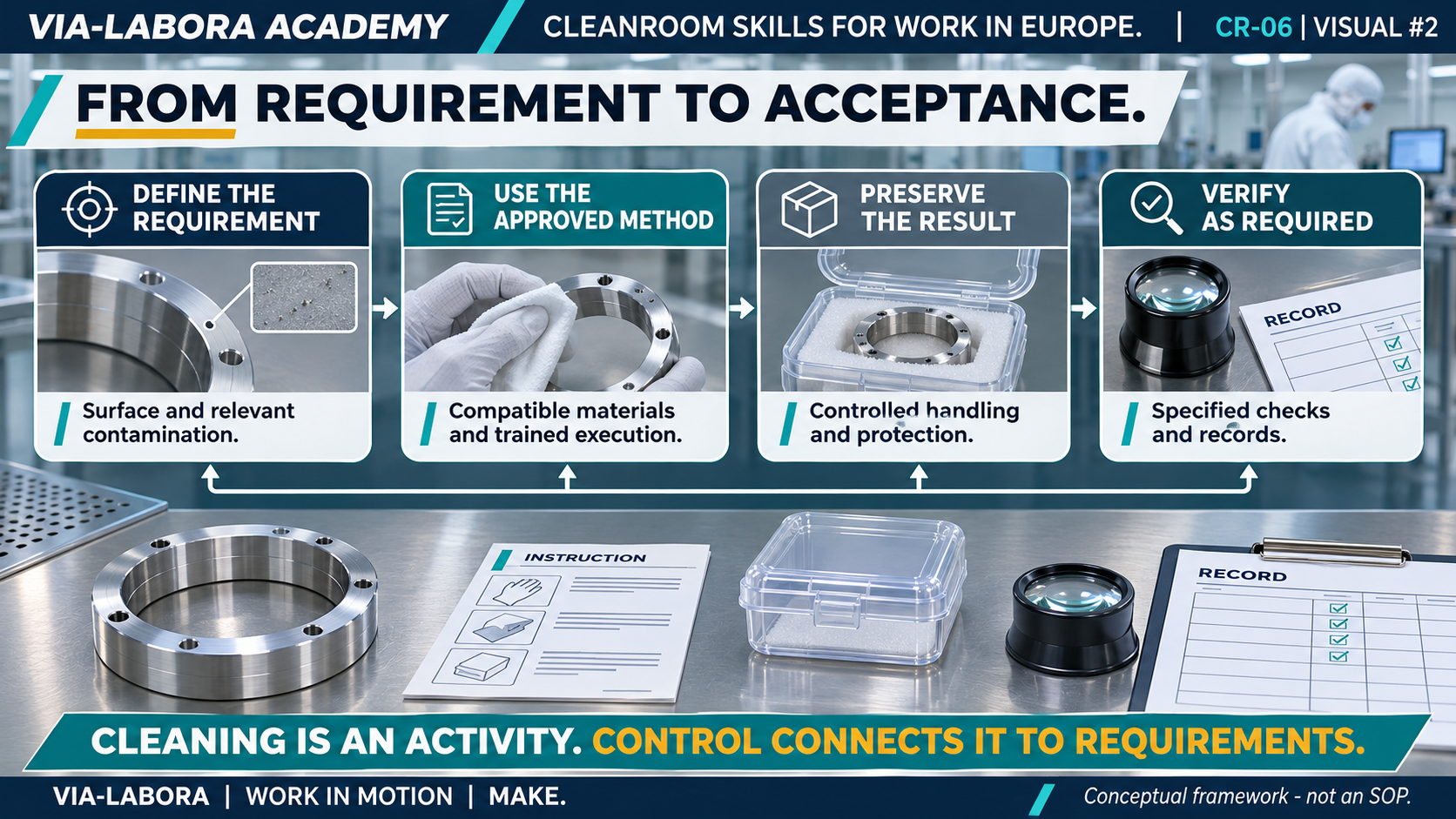
Caption: Requirements, method, protection and evidence are connected. The diagram is a reasoning framework, not an operating sequence or test plan.
Terminology EN / PL
| English | Polish | Meaning |
|---|---|---|
| Cleaning | Czyszczenie | Removal of unwanted contamination. |
| Controlled cleaning | Czyszczenie kontrolowane | Cleaning governed by requirements and approved controls. |
| Residue | Pozostałość | Material remaining on a surface; significance depends on the process. |
| Compatibility | Kompatybilność | Suitability of the method/material combination for its intended use. |
| Recontamination | Ponowne zanieczyszczenie | Introduction of contamination after preparation. |
| Verification | Weryfikacja | Checking specified requirements using required evidence. |
| Validation | Walidacja | Establishing suitability for intended use where required. |
| Acceptance criteria | Kryteria akceptacji | Requirements used to determine acceptability. |
| Traceability | Identyfikowalność | Ability to follow relevant identity and history through records. |
Process Explanation
Use these questions with the actual instruction. They are not permission to clean:
- What item, surface and process stage are involved?
- What contamination and acceptance requirements matter?
- Is the task within my training and authorisation?
- Which instruction, materials and parameters apply?
- How must the prepared item be protected?
- What checks, records and acceptance decisions are required?
- What is the response when a condition falls outside the instruction?
Practical Scenario
An operator notices a mark near a bonding surface. A familiar solvent is available. The operator has used it elsewhere but cannot find approval for this component.
The observation is “a visible mark”, not a confirmed chemical identification. The operator should avoid an improvised cleaning attempt and use the applicable clarification route. An authorised assessment determines the required next action. If contact already occurred, report the actual event and preserve status according to the procedure. Do not independently reject, release or rework the part.
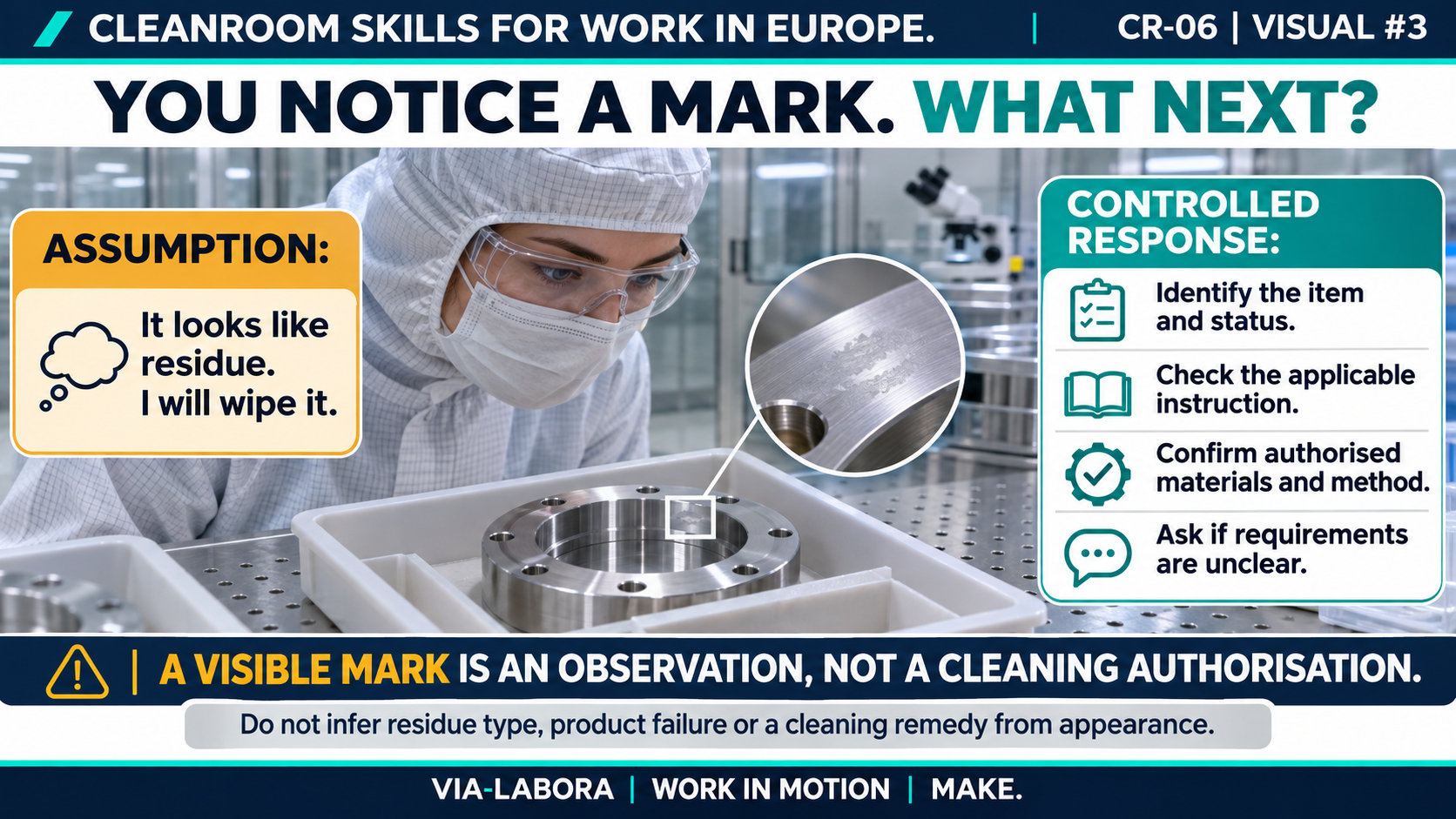
Caption: Recognise missing information before acting. The scene does not identify residue chemistry or prescribe a remedy.
Common Mistakes and Risks
- Familiar agent: previous use does not establish local approval or compatibility.
- Any white wipe: colour does not establish suitability.
- More cleaning: repeated contact can redistribute contamination or affect a surface.
- Appearance equals acceptance: the required checks may assess other characteristics.
- Unprotected cleaned item: subsequent contact can affect its condition.
- “Cleaning means disinfection”: these have different purposes.
- Invented completion record: records must reflect what was actually done and checked.
What Depends on the Site SOP?
Scope of cleaning, approved materials, agent selection, hazard controls, parameters, equipment, technique, required drying or subsequent processing, protection, checks, records and release authority. Frequency and response to unexpected marks are also context-dependent. Use product documentation and manufacturer instructions where specified. This lesson sets no chemical recipe or universal technique.
Practical Exercise
An item looks clean. The wipe is known, but the agent and required check status are unknown. List facts, unknowns and a next step within your authority.
Show suggested response
Known—appearance and wipe identity. Unknown—agent approval, compatibility, completed method and evidence. Establish status through the approved route before affected use. Do not simply clean again, infer failure or fill missing records from memory.
Knowledge Check
1. Is controlled cleaning a different ISO room class?
Show answer
No. It describes controls around a cleaning task in this lesson.
2. Does a visibly clean surface meet every requirement?
Show answer
Not established. Required evidence depends on the specification.
3. Is a familiar agent acceptable on every component?
Show answer
No. Approval and compatibility are task-specific.
4. Does more wiping always improve the result?
Show answer
No. It can redistribute contamination or affect the surface.
5. Does a cleanroom classification establish surface acceptance?
Show answer
No. Air and surface requirements are different.
6. Must every cleaning operation be described as validated?
Show answer
No. Follow the actual applicable requirements and terminology.
7. What if a mark falls outside the instruction?
Show answer
Safely pause the affected activity and use the defined clarification route. Do not improvise a remedy or machine shutdown.
Use It in a Technical Interview
Explain product → task → approved method → protection → checks → responsibility.
Truthful example: “I cleaned precision parts under approved instructions, used specified materials, protected prepared items and completed the required records. Acceptance decisions were made within the defined authority.” Describe only tasks and checks you actually performed. General housekeeping can be valuable experience, but is not automatically equivalent to precision-component cleaning.
Use It With Your Team
Choose one real task. Can the team locate the current instruction, approved consumables, protection requirements and verification route? Who can authorise rework or resolve an unexpected mark? Discuss unclear requirements without creating an informal replacement procedure. Practical competence needs observation against the actual method, not just correct quiz answers.
Key Takeaways
Looks clean does not establish conformity. Cleaning must match the surface, contamination and next process. Approved materials need correct use. Protect the result. Verification, validation and release are different. Ask before improvising.
Downloadable Resource
Cleaning Process Understanding Check — EN/PL. One page per language, completed with a trainer. Record the item, requirement, instruction, materials, protection, evidence and clarification route. It is a learning aid—not an SOP, release record or authorisation to clean.
Candidate CTA / B2B CTA
Candidates: Describe real products, tasks, materials, training and responsibilities. State what you performed and what required another authorised person. Contact technicals@via-labora.com or WhatsApp +48 504 016 136 about relevant opportunities or the Technical Talent Pool. Availability and requirements vary.
Employers and partners: Discuss role-specific screening with VIA-LABORA. Distinguish general cleaning from controlled cleaning experience by exploring method awareness, compatibility, protection, records and escalation. Site training and practical assessment remain necessary.
Previous / Next Episode
Previous: CR-05 — Entering & Leaving the Cleanroom.
Next: CR-07 — Handling Components Without Contaminating Them. Cleaning is only useful if the required condition is preserved during subsequent handling.
References
ISO 14644-5:2025 — Operations: operational framework including cleaning programmes; it does not establish product-specific cleaning methods or agent compatibility.
ISO 14644-13:2026 — Surface cleaning guidance: guidance for surface cleaning; its scope excludes the product produced in a cleanroom and detailed product-cleaning procedures.
The standards provide context and do not certify this article. Component scenarios depend on product and site documentation.