WELD-06 · Foundation · 30–40 minutes with practice
Same process. Different position. Different challenge.
A process number tells you which welding process is used. A position designation describes how the weld is oriented during welding and, where relevant, its direction of progression.
Two people may both have MAG experience while having worked in very different positions.
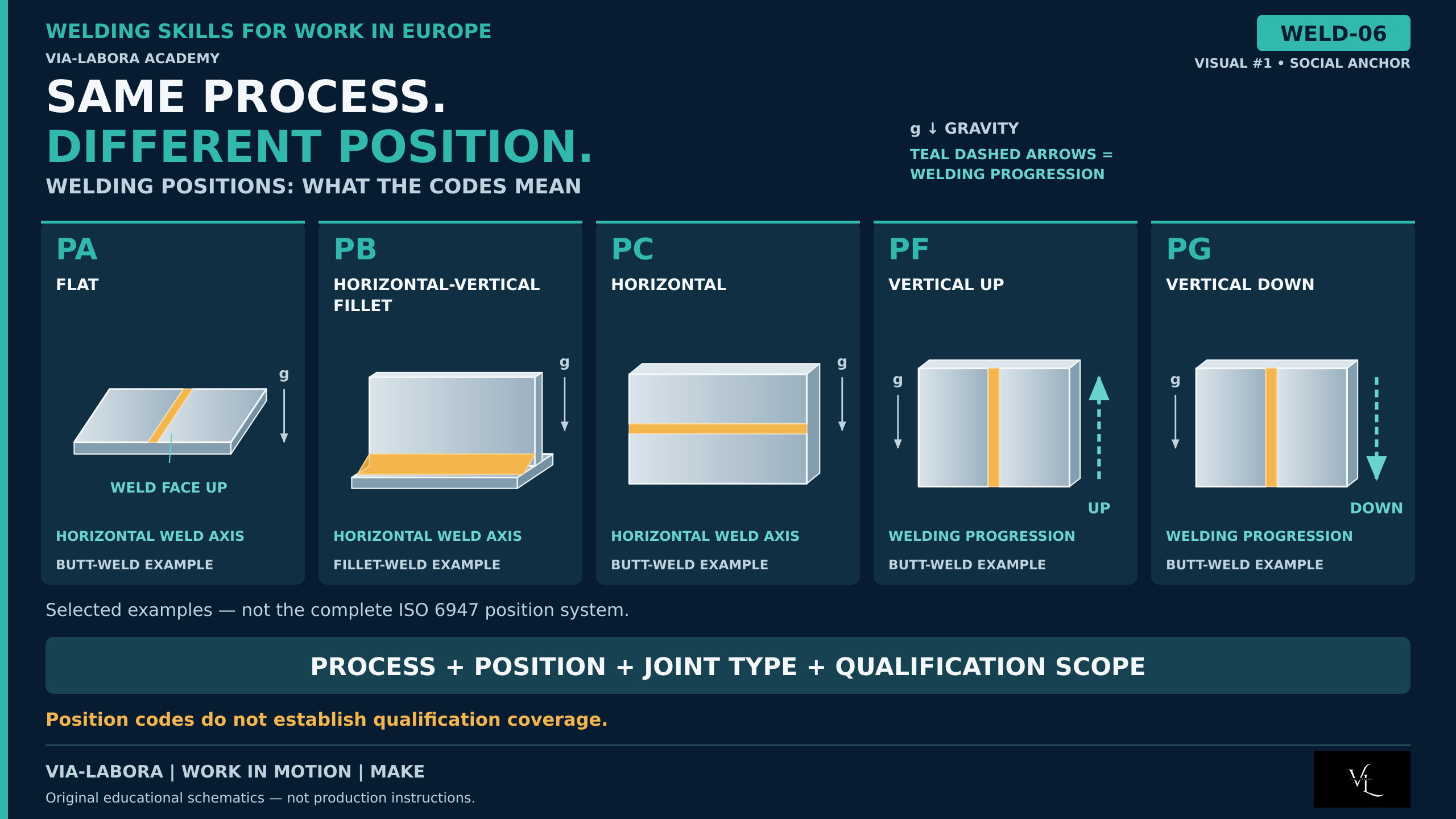
Caption:
“Five selected introductory position codes, not the complete ISO 6947 system. Read joint orientation and progression together. A position designation does not establish qualification coverage.”
Situation from work
Two candidates describe themselves as MAG welders.
Candidate A mainly welded fillets in PA/PB.
Candidate B also welded butt joints vertically upwards in PF.
Their process description alone does not establish comparable experience or suitability for a particular task.
Before assigning work, compare the actual joint, material, dimensions, position, procedure and qualification requirements.
Who is this for?
Welders, fabricators, technical candidates, recruiters and team leaders who need to describe welding work accurately.
You will gain:
- A practical vocabulary for common position codes.
- A way to distinguish orientation from process.
- Better questions for interviews and work allocation.
Learning objectives
After this lesson, you should be able to:
- Explain process versus position.
- Recognise the main plate-position examples.
- Distinguish vertical-up from vertical-down.
- Explain why pipe work needs additional orientation information.
- Separate practical experience from qualification coverage.
- Complete a structured experience record without inventing approval scope.
Connection to previous lessons
WELD-01–05 concerned drawings and requirements.
This lesson moves to how the weld is positioned during execution.
Do not confuse:
- Arrow side/other side: designation of location.
- Field/site: execution assignment.
- PA, PB and other position codes: welding position.
Technical explanation
1. Read orientation relative to gravity
A component’s name does not determine the position.
Consider how the weld axis and weld face are oriented, and whether the workpiece remains fixed or rotates.
For vertical welding, progression direction is important.
The welder’s body posture is not the position designation. Nor does the direction of a drawing arrow automatically establish it.
2. Common introductory positions
| Code | Name | Introductory example |
|---|---|---|
| PA | Flat | Welding from above in a flat-position arrangement. |
| PB | Horizontal-vertical | A horizontal fillet between vertical and horizontal surfaces. |
| PC | Horizontal | A horizontal butt weld on a vertical face. |
| PD | Horizontal-overhead | An overhead fillet arrangement. |
| PE | Overhead | An overhead butt-weld arrangement. |
| PF | Vertical up | Vertical welding progressing upwards. |
| PG | Vertical down | Vertical welding progressing downwards. |
These examples help identify the categories. Exact angular limits and specialised arrangements must be checked against ISO 6947 and the applicable documentation.
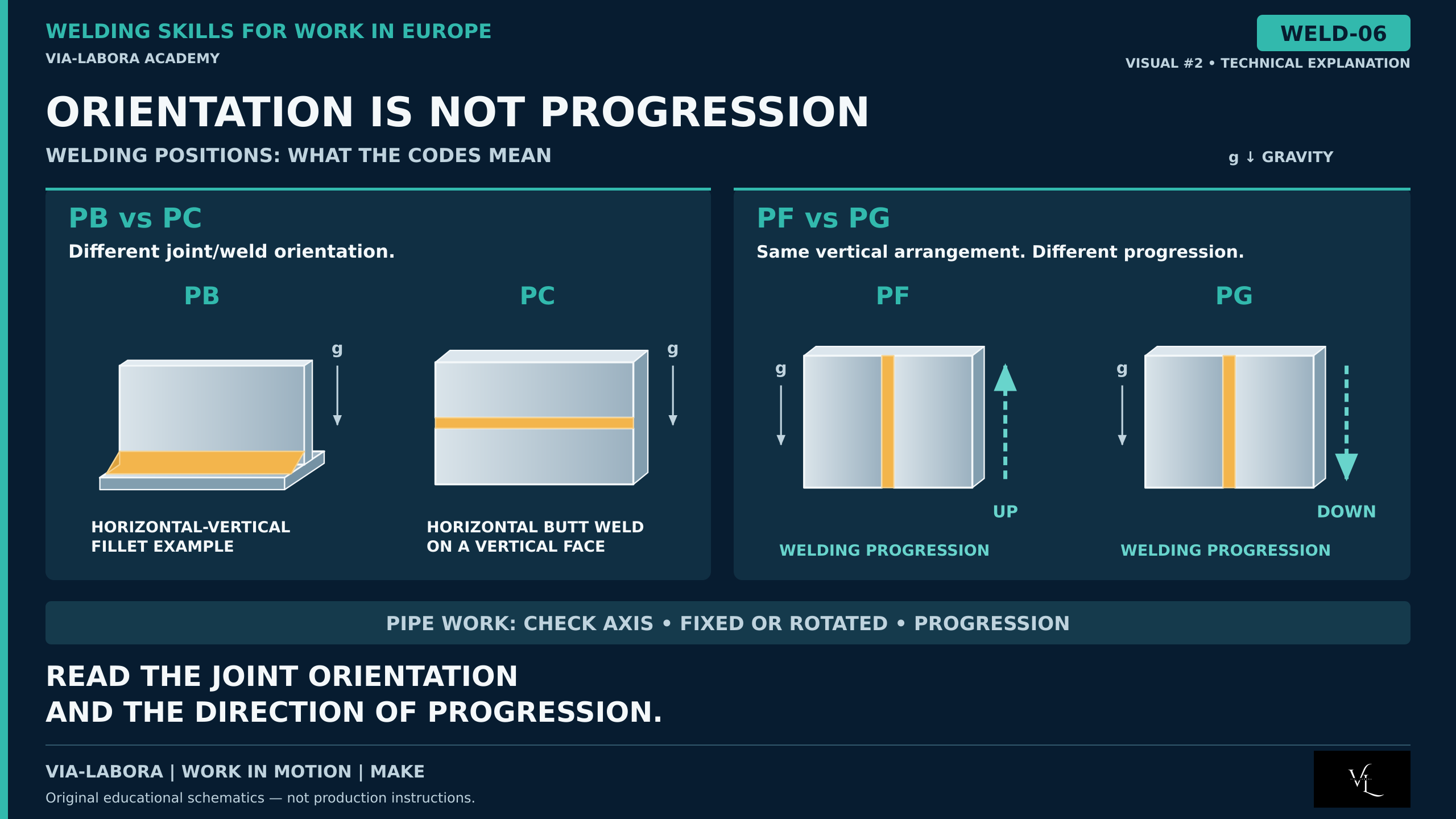
PA is not restricted to one weld family. PB and PC should not be treated as interchangeable labels.
3. PF and PG differ
PF progresses upwards; PG progresses downwards.
Do not switch between them simply because the joint remains vertical.
The specified procedure, consumables, material, thickness and application matter. This lesson supplies no universal parameter changes or travel techniques.
4. Why position affects execution
Gravity changes how the molten pool is supported. Orientation also changes access and the relationship between the torch or electrode and joint.
The practical result depends on the process and complete task.
Avoid declaring one position universally easy and another universally difficult. A controlled setup in one application may differ greatly from another.
5. Pipe work needs more than “pipe welding”
Ask:
- Is the pipe fixed or rotated?
- What is its axis orientation?
- What is the progression direction?
- Which code and arrangement are specified?
For introductory recognition:
- PH is associated with upward progression around a fixed horizontal-axis pipe.
- PJ is associated with downward progression in that arrangement.
- H-L045 and J-L045 identify inclined fixed-pipe arrangements with upward and downward progression respectively.
These are orientation examples, not qualification equivalence tables.
A weld around a fixed pipe passes through changing local orientations. Do not label the entire task solely from the position visible at one point.
Do not assume that rotated pipe work has the same designation as an otherwise similar fixed-pipe task.
6. Four separate questions
| Question | What to check |
|---|---|
| What work has the person performed? | Practical experience and evidence. |
| What is the person qualified for? | Applicable certificate, scope and validity conditions. |
| How must this job be executed? | Applicable WPS and work instructions. |
| What supports the procedure? | Applicable procedure-qualification route and records. |
A WPS is not a welder certificate. A procedure qualification is not a personal qualification.
ISO 6947 describes positions. ISO 9606-1 addresses qualification testing for fusion welding of steels within its scope. Other materials and applications require the appropriate provisions.
Do not derive a qualification range from a position-code list.
7. International comparison
AWS/ASME notation may appear in customer documentation.
Do not automatically replace an ISO code with a G/F number or infer identical qualification coverage. Check the system, test arrangement and governing requirements.
This lesson does not provide a universal conversion table.
Terminology EN/PL
| EN | PL |
|---|---|
| Welding process | Proces spawania |
| Welding position | Pozycja spawania |
| Flat | Podolna |
| Horizontal-vertical | Naboczna |
| Horizontal | Naścienna |
| Horizontal-overhead | Okapowa |
| Overhead | Pułapowa |
| Vertical up | Pionowa z dołu do góry |
| Vertical down | Pionowa z góry na dół |
| Progression direction | Kierunek postępu spawania |
| Fixed pipe | Rura nieruchoma |
| Rotated pipe | Rura obracana |
| Qualification scope | Zakres kwalifikacji |
Step-by-step interpretation
- Confirm the task documentation.
- Identify process, material and weld/joint type.
- Establish component and weld orientation.
- For pipe, establish axis orientation and fixed/rotated condition.
- Identify progression direction where relevant.
- Read the specified position and applicable procedure.
- Check experience and qualification documents separately.
- Raise mismatches before work allocation.
This is a review method, not a normative approval sequence.
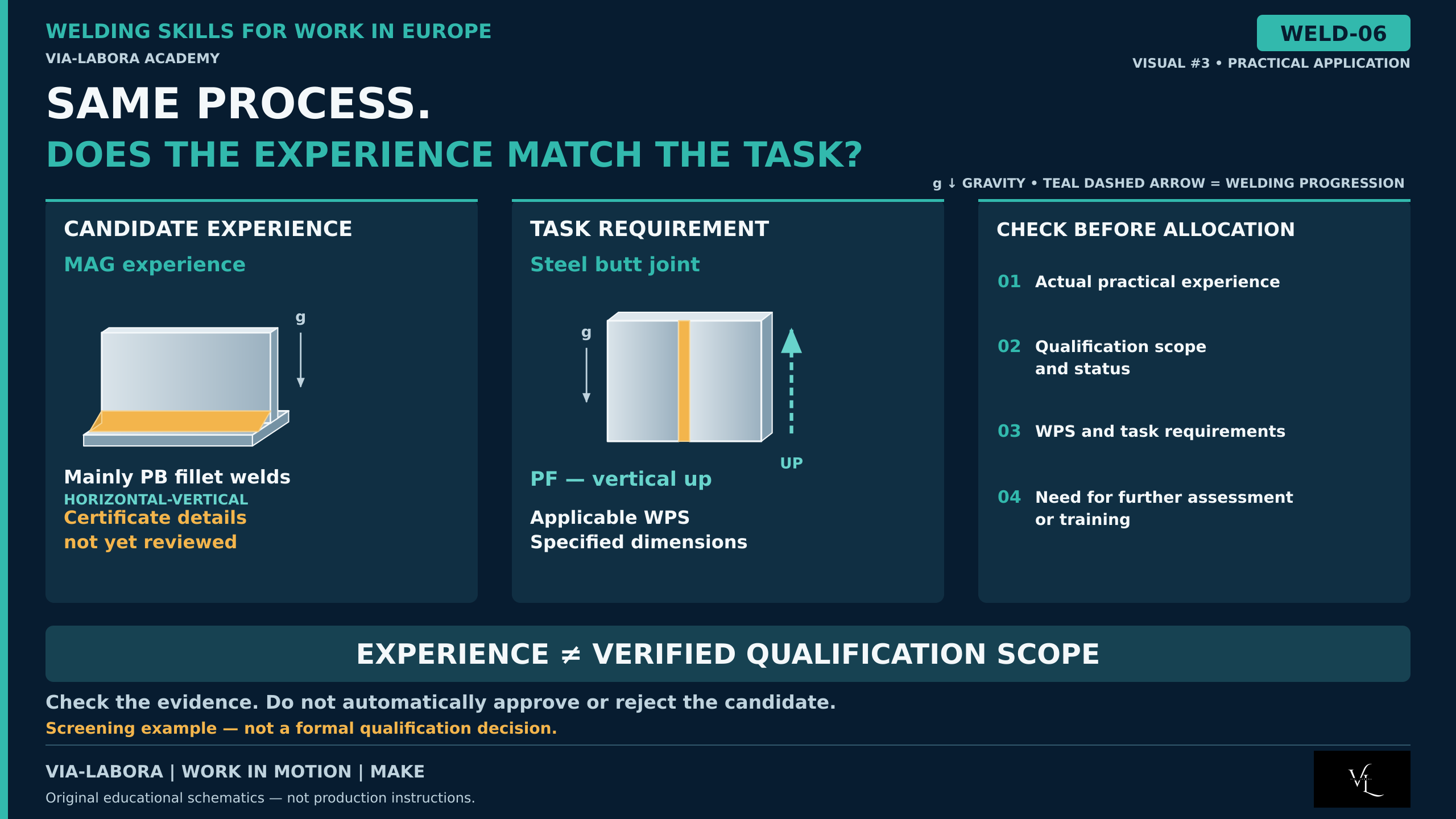
Worked example — VL-P601
Task:
Steel butt joint, vertical-up execution under the applicable WPS.
Candidate:
MAG experience, mainly PB fillets.
Certificate details unavailable.
Reasoning:
- A process-family description does not establish the exact task match.
- PB fillet experience is not evidence of PF butt-weld experience.
- Missing certificate details prevent confirming qualification coverage.
- Review documents and determine whether training, a practical assessment or further qualification is needed.
Do not announce that the person is either qualified or unqualified from these facts alone.
Further example — a rotating fixture
Two pipe tasks look similar in a photograph. One pipe is rotated during welding; the other remains fixed.
The photograph alone is insufficient to establish the complete execution arrangement.
Ask about rotation, axis and progression before assigning a code.
Common mistakes
- Treating 141 or 135 as a position.
- Calling PB simply “fillet” without orientation.
- Confusing PB and PC.
- Treating PF and PG as interchangeable.
- Describing every pipe job with the same position.
- Inferring qualification coverage from experience.
- Treating a WPS as a personal certificate.
- Guessing production limits from schematic pictures.
Try it yourself
A candidate writes:
“MAG welder. All positions. Pipe experience.”
The task involves fixed pipe, specified upward progression and a defined WPS.
Write five follow-up questions.
Show suggested answer
- Which exact processes have you used?
- Which materials, dimensions and weld types?
- Was the pipe fixed or rotated, and how was its axis oriented?
- Which positions and progression directions have you actually performed?
- Which current qualification documents cover the required task?
Also ask for concrete work examples and review the task documentation. Do not treat the answers alone as formal approval.
Knowledge check
1. Does process 141 specify position?
Show answer
No. Process and position answer different questions.
2. Are PB and PC interchangeable?
Show answer
No. Their introductory fillet/butt orientation examples differ.
3. Does PF mean upward progression?
Show answer
Yes.
4. Can PG automatically replace PF?
Show answer
No. Check the procedure and task.
5. Does pipe diameter alone identify the position?
Show answer
No. Orientation, rotation and progression matter.
6. Does ISO 6947 establish a welder’s complete qualification range?
Show answer
No.
7. What must be compared before allocation?
Show answer
Task requirements, procedure, practical competence and applicable qualification documents. This is a learning check, not certification.
Use it in a technical interview
Prepare a specific statement:
“I used [process] on [material and weld type], in [positions], over [dimensions], performing [tasks]. My qualification documents are available for scope review.”
Keep actual experience and certificate scope separate.
Use it with your team
Before a new assignment:
- One person identifies the production arrangement.
- Another checks the applicable WPS.
- The responsible person reviews competence and qualifications.
Discuss access or fixture changes before they alter the execution arrangement.
Key takeaways
Process is not position.
Orientation and progression both matter.
PB is not PC; PF is not PG.
Pipe work needs fixed/rotated and axis information.
Experience, WPS and qualification are separate evidence.
Practical bonus — Welding Experience Check
Candidate name: ______
Process/reference: ______
Material: ______
Weld/joint type: ______
Position and progression: ______
Plate/pipe: ______
Thickness: ______
Pipe outside diameter, where relevant: ______
Fixed/rotated and axis orientation: ______
Actual tasks and examples: ______
WPS-based experience: ______
Certificate reference/standard: ______
Qualification scope: ______
Status/validity evidence: ______
Unresolved questions: ______
Mark candidate statements separately from verified documentary findings.
This record supports preparation and screening. It does not issue qualification or approval.
Previous / next
← WELD-05 — All-Around, Field/Site & Supplementary Information
Next: WELD-07 — Process Numbers: 111, 135, 136, 141.
Candidates
Describe your actual processes, positions, materials and joint experience.
Contact VIA-LABORA about opportunities and the Technical Talent Pool:
technicals@via-labora.com
WhatsApp +48 504 016 136
No specific vacancy is asserted.
Employers
Discuss preselection using process, material, joint, position, dimension, WPS, certificate and fabrication requirements.
marcin.ciupka@via-labora.com
References
ISO 6947:
ISO reference
ISO 9606-1:
ISO reference
Editorial check: 16 November 2026.
Use the applicable edition and project requirements. No qualification-range table is supplied.