WELD-03 · Foundation · approximately 30 minutes with practice
Read the weld type. Joint shape alone is not enough.
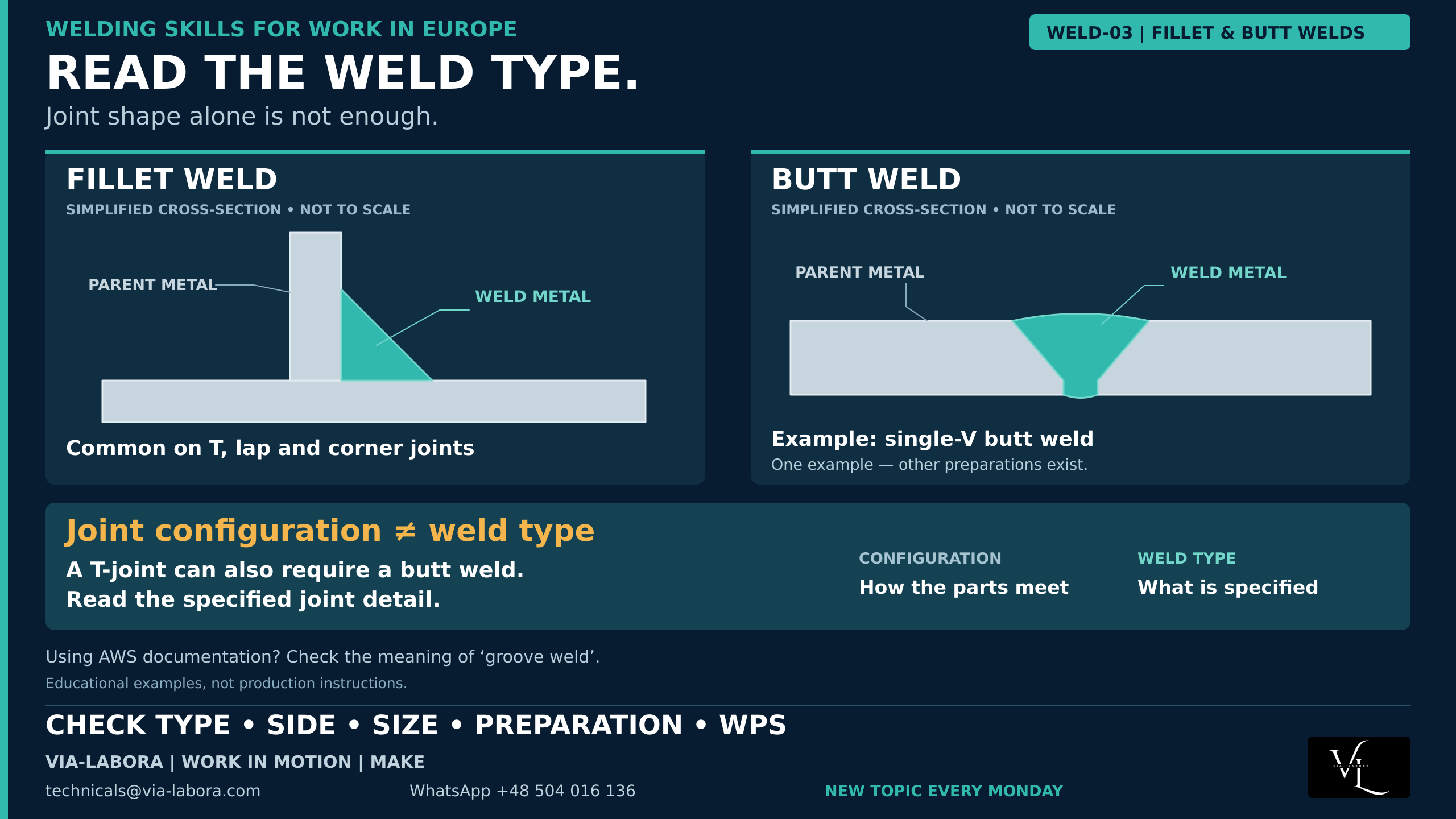
A T-shaped assembly does not automatically specify a fillet weld. Separate how components meet, how they are prepared and what weld is required.
View the original board at full size (new tab)
Situation from work
You receive a bracket and base plate. They look like a familiar T-joint, so a colleague suggests repeating the previous fillet-weld detail.
The current drawing, however, specifies a prepared T-butt arrangement.
Before fitting the parts, distinguish the familiar overall shape from the current requirements. Do not choose a replacement arrangement independently.
Who is this for, and what will you gain?
For welders, fabricators, fitters, candidates and team leaders.
You will gain clearer terminology, a method for checking preparation before work and better evidence for describing your experience.
Review WELD-01 for documentation and WELD-02 for side location.
Learning objectives
After this lesson, you should be able to:
- Separate configuration, preparation and weld type.
- Recognise the anchor’s fillet and butt examples.
- Explain why a T-joint does not automatically select a weld.
- Recognise that single-V is only one example.
- Identify missing preparation information.
- Describe experience without confusing it with qualification scope.
Technical explanation
Three separate questions
| Question | Information category |
|---|---|
| How do the parts meet? | Joint configuration |
| What edge/surface preparation is required? | Joint preparation |
| What weld is specified? | Weld type |
A correct description keeps these categories distinct.
Read the anchor
The left panel uses an internal-corner fillet example. The right uses a single-V butt example.
The central message matters more than memorising the pictures: configuration alone does not establish the weld.
TWI illustrates fillet, T-butt and compound arrangements:
Open reference
Preparation must be read separately
Check the specified edge shape, opening, root face, backing and other applicable details.
Do not copy numerical values from an undimensioned teaching illustration. A V example does not prescribe a universal angle or gap.
Weld type does not establish every requirement
The name alone does not determine size, required penetration, examination or acceptance.
Do not infer complete penetration from “butt weld”, or internal soundness from a smooth visible cap.
Likewise, a familiar fillet outline does not establish its required dimensions or acceptability.
Symbols are not scaled sections
Read elementary symbols within the complete designation.
The drawn size of a triangle is not its specified physical size. A preparation indication must be read with the actual dimensions and instructions.
ISO symbolic-representation reference:
Open reference
AWS terminology
When working with AWS documentation, check its governing definitions and rules. Do not use “groove weld” as an unrestricted word-for-word replacement for every European term.
The joint arrangement and the weld terminology remain separate questions.
This lesson uses ISO/European context. It is not a full ISO/AWS comparison.
- How do the parts meet?
- What preparation is specified?
- What weld is specified?
Terminology
| EN | PL | Working meaning |
|---|---|---|
| Joint configuration | Konfiguracja złącza | How components meet. |
| Joint preparation | Przygotowanie złącza | Specified preparation of joining edges/surfaces. |
| Weld type | Rodzaj spoiny | The specified weld geometry. |
| Fillet weld | Spoina pachwinowa | The weld family illustrated at the anchor’s internal corner. |
| Butt weld | Spoina czołowa | The family illustrated by the single-V example; not limited to that preparation. |
| Parent metal | Materiał podstawowy | Component material. |
| Weld metal | Metal spoiny | Metal forming the weld. |
| Weld face | Lico spoiny | Exposed weld surface on the side considered. |
| Weld toe | Brzeg spoiny | Junction of weld face and parent metal. |
| Weld root | Grań spoiny | Root region, interpreted for the joint detail. |
These working descriptions introduce the examples. Specialised interpretation requires the applicable definitions.
Step-by-step interpretation
- Confirm drawing and revision.
- Locate the joint and side.
- Describe the configuration.
- Read the specified weld.
- Locate preparation requirements.
- Check the applicable WPS and instructions.
- Continue checking size and other requirements.
- Resolve contradictions before the affected operation.
This is practical review guidance, not a prescribed normative sequence.
Worked example — VL-T301
Available information:
- Components form a T-joint.
- Current detail specifies a prepared T-butt arrangement.
- Previous job used a fillet arrangement.
Reasoning:
- “T-joint” answers how the parts meet.
- The current detail answers which arrangement is required.
- Previous experience does not override it.
- Preparation must be established before fitting.
Useful clarification:
“Could you confirm the preparation detail and applicable WPS for VL-T301 before fit-up?”
Do not add preparation dimensions to this training example.
Further workshop examples
A single-V teaching picture is offered as a universal preparation.
Reject that assumption and read the actual detail.
A smooth cap is offered as proof of required penetration.
Separate appearance from the specified internal and inspection requirements.
Local and general instructions appear inconsistent.
Identify the document, detail and conflict; use the workplace clarification process.
Common mistakes
- Calling every T-joint a fillet weld.
- Treating joint, preparation and weld as interchangeable.
- Assuming every butt weld uses single-V preparation.
- Copying dimensions from a schematic.
- Inferring penetration from a cap or weld name.
- Replacing the specified detail with a larger familiar weld.
- Assuming experience establishes certificate coverage.
Practical exercise
Classify:
A. “The vertical plate meets the base in a T arrangement.”
B. “The drawing specifies a fillet weld on the designated side.”
C. “Preparation follows detail P3.”
D. “It looks like last month’s bracket, so the weld must be identical.”
Tasks:
Identify configuration, weld type and preparation.
Find the unsupported assumption.
State what you would check before work.
- A. Vertical plate meets the base in a T arrangement.
- B. Drawing specifies a fillet weld on the designated side.
- C. Preparation follows detail P3.
- D. A similar previous bracket means the weld must be identical.
Show suggested answers
A: Configuration.
B: Weld type and side.
C: Preparation reference.
D: Unsupported assumption.
Check the current drawing, complete designation, preparation detail and applicable procedure.
Knowledge check
1. Does a T-joint automatically require a fillet weld?
Show answer
No. Read the specified weld arrangement.
2. Does the anchor prescribe every butt-weld preparation?
Show answer
No. It shows one example.
3. Does a smooth cap prove complete penetration?
Show answer
No.
4. Can extra weld metal automatically replace a specified detail?
Show answer
No. Changes need appropriate technical authorisation.
5. Which is more precise: “T-shaped, so obvious” or “T configuration; weld and preparation specified separately”?
Show answer
The second statement separates the categories.
6. Does experience with a weld family automatically establish qualification coverage?
Show answer
No. Check the applicable qualification documents.
Use it in a technical interview
Give concrete examples of configurations, welds, materials, processes, positions and preparation tasks you have performed.
Useful wording:
“I identify the configuration, then read the specified weld and preparation. I check side, size and WPS before proceeding.”
State separately which certificates you hold. Their coverage requires document review.
Use it with your team
Use an approved training detail.
Ask three people to identify:
- Configuration.
- Preparation.
- Weld type.
Then check whether everyone used the same evidence.
Discuss what must be clarified before cutting, machining or fit-up. Do not let a team assumption replace the specified detail.
Key takeaways
Configuration, preparation and weld type answer different questions.
The anchor gives examples, not universal production details.
Read the current specification.
Do not infer dimensions, penetration or acceptance from appearance.
Check type, side, size, preparation and WPS together.
Practical bonus — Before Preparation Card
Drawing/revision/detail: ______
Configuration: ______
Specified weld: ______
Side: ______
Preparation reference: ______
Size reference: ______
Applicable WPS: ______
Question: ______
☐ Current documents.
☐ Categories separated.
☐ Preparation located.
☐ Contradictions raised.
WELD-03 · 2026-11-06 · https://via-labora.com/academy/welding/weld-03-fillet-butt-joint-weld-terminology/
Previous / next
Previous: WELD-02 — Reference Line, Arrow & Weld Location.
Next: WELD-04 — Weld Size, Length & Pitch.
Candidates
Describe actual weld types, preparation and fabrication tasks alongside processes, materials, positions and qualifications.
Welding opportunities and Technical Talent Pool:
technicals@via-labora.com
WhatsApp +48 504 016 136
Employers
Discuss preselection using processes, materials, positions, thickness/diameter range, drawing competence, WPS experience, certificates and fabrication work.
marcin.ciupka@via-labora.com
References and scope
ISO 2553:
Open reference
TWI:
Open reference
Editorial check: 6 November 2026.
Examples supply no production parameters or qualification ranges. Apply the project documentation.
Additional explanations and original examples
Core theory
1. Separate three questions
Before preparing a joint, separate:
| Question | What it concerns |
|---|---|
| How do the components meet? | Joint configuration |
| How are the joining edges or surfaces prepared? | Joint preparation |
| What weld is specified? | Weld type |
These questions are related, but their answers are not interchangeable.
For example, “T-joint” describes the arrangement. It does not fully specify preparation or weld type.
2. Joint configuration: how the parts meet
Common introductory configurations include butt, T, lap, corner and edge arrangements.
Use these names to describe the component relationship. Do not treat the name alone as a complete welding instruction.
ISO 17659 provides illustrated terminology for joints, preparation and welds:
Open reference
3. Read the two weld examples in the anchor
The anchor shows a fillet weld at an internal corner and a single-V butt-weld example between aligned components.
It also identifies parent metal and weld metal. These colours help you distinguish the original components from the represented welded region.
These examples illustrate geometry. Their proportions do not provide dimensions, preparation settings or acceptance criteria.
4. Joint configuration does not select the weld automatically
Fillet welds are commonly used in T, lap and corner arrangements. A T arrangement can also use a butt weld or a combined butt-and-fillet detail.
That is why the anchor states:
“Joint configuration ≠ weld type.”
Check the designated weld and section detail instead of selecting a familiar solution from the outline alone.
The distinction and T-butt examples are explained in:
Open reference
5. Preparation is a separate requirement
Preparation may involve a specified edge shape, opening, root face, backing arrangement or other details.
Do not derive numerical preparation values from the infographic.
A single-V drawing is an example of one preparation. It does not establish a universal angle, root opening or requirement to prepare every butt weld in the same way.
Look for the required detail in the drawing and supporting instructions. Resolve missing or conflicting information before the affected preparation.
6. Weld type does not establish every performance requirement
Naming a weld type does not establish its dimensions, penetration requirement, examination or acceptance criteria.
Do not assume:
- Every butt weld requires complete penetration.
- A visible cap proves internal fusion.
- A fillet weld is automatically acceptable because its outline looks triangular.
- A larger weld can replace the specified detail.
Those questions require the relevant design, procedure and quality requirements.
7. Symbols are not realistic pictures
An elementary symbol is part of a technical designation. It is not a scaled section of the completed weld.
Use the symbol together with its location, dimensions, notes and references.
A triangular fillet-weld symbol does not provide its size by shape alone. Likewise, a V-shaped indication must be read within the complete designation rather than treated as a complete preparation drawing.
ISO 2553 is the reference for symbolic representation:
Open reference
8. A note on AWS terminology
The anchor mentions “groove weld”.
When using AWS-based documentation, check its definitions and symbol rules. Do not assume that “butt joint”, “butt weld” and “groove weld” are interchangeable descriptions.
In particular, distinguish the component arrangement from the weld terminology used by the governing document.
This lesson uses European/ISO-oriented terminology. A detailed ISO/AWS comparison belongs in a separate lesson.
Original practical examples
Example 1 — Familiar bracket, different instruction
Training assembly VL-T301 consists of a vertical plate meeting a base plate.
You identify a T-joint. A colleague suggests a fillet weld because that was used on the previous job.
However, the current detail identifies a prepared T-butt arrangement.
Correct approach:
Retain the configuration description, but follow the current specified detail. Check the preparation and applicable instructions before work.
Lesson:
Recognising the arrangement is the start of interpretation.
Example 2 — The single-V assumption
Training assembly VL-B302 shows two aligned plates.
A learner says:
“All butt welds need the same V preparation as the infographic.”
Correct approach:
Check the actual preparation. The infographic shows one example and supplies no numerical requirements.
Lesson:
An educational illustration is not a universal preparation instruction.
Example 3 — A convincing external profile
A completed weld has a smooth external surface.
Someone concludes:
“The appearance proves the required penetration.”
Correct approach:
Separate appearance from the specified penetration and examination requirements. Follow the inspection documentation.
Lesson:
External shape alone cannot establish all internal characteristics.
Example 4 — Conflicting information
The local detail and a general instruction appear to describe different weld arrangements.
Correct approach:
Identify the drawing, detail and conflict. Ask the responsible person to resolve it through the workplace process.
Example question:
“On VL-T304, detail C, the local section and the general instruction appear to specify different weld arrangements. Could you confirm the intended detail before preparation?”