In CR-01, we learned that looks clean does not mean verified clean.
Now we look at the environment around the product. What does an ISO cleanroom class describe? Why does a lower number indicate a lower permitted airborne particle concentration? And why must an ISO class never be confused with an operator’s job grade?
The central distinction is simple:
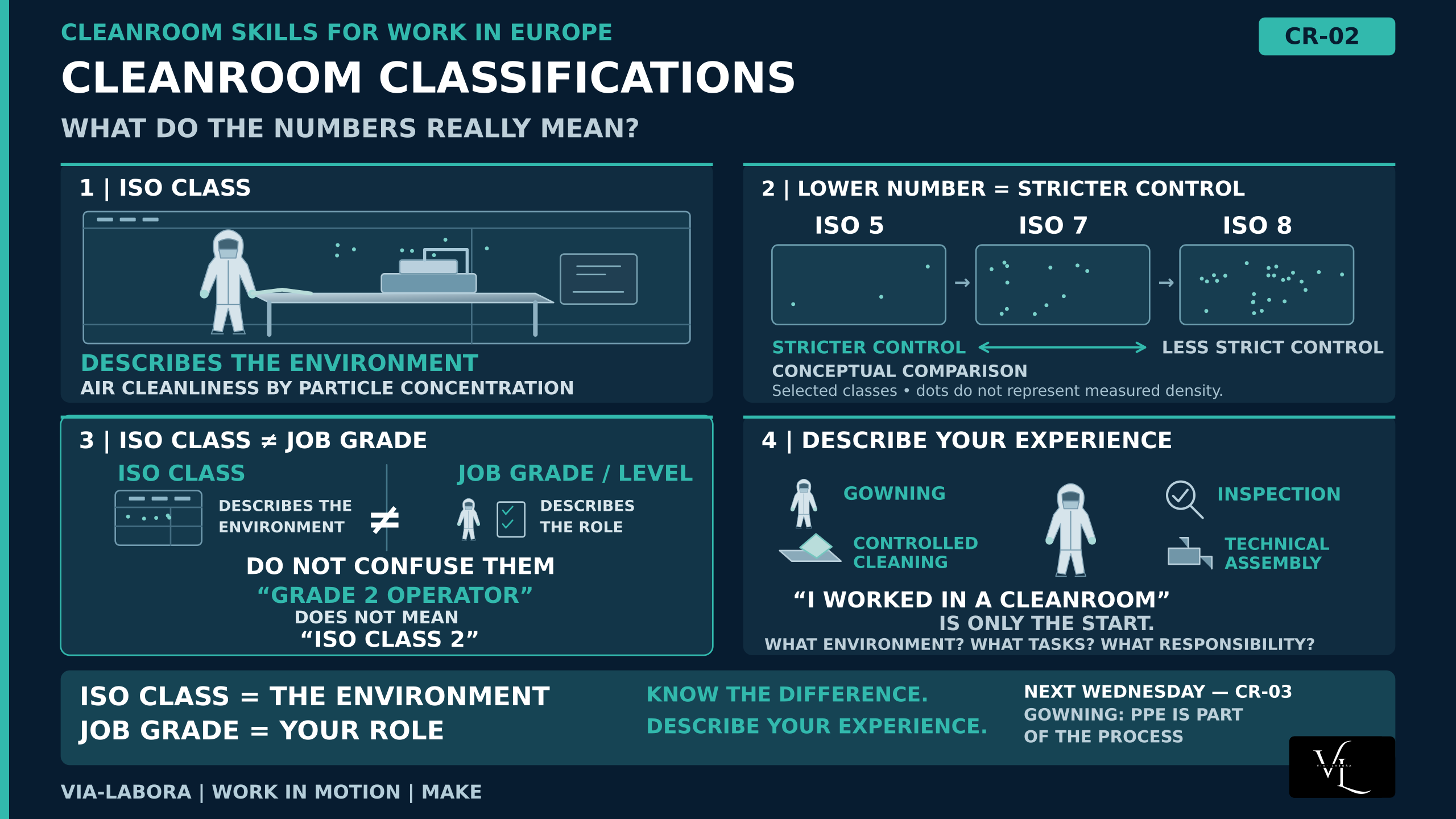
ISO CLASS describes airborne particle cleanliness.
JOB GRADE describes a role within a company’s system.
View full-size graphic (opens a new tab) ↗
Situation from work
A candidate says, “I was a Grade 2 operator, so I worked in ISO Class 2.” Another says, “I worked in ISO Class 7,” but does not explain any tasks. Neither statement gives enough reliable information: the first confuses two systems; the second describes an environment without establishing practical competence.
Who is this for?
Candidates reading cleanroom job descriptions, operators preparing a CV or interview, and employers or partners clarifying what a classification claim actually tells them.
What will you gain?
Candidates can separate ISO Class from Job Grade and describe their environment, tasks and responsibility accurately. Employers and partners can ask more precise screening questions without treating a room class as proof of competence.
- Understand airborne particle classifications
- Distinguish ISO Class from company Job Grade
- Describe actual cleanroom tasks and responsibilities
Why this matters at work
Cleanroom classifications appear in job descriptions, workplace signs and technical documentation.
Understanding them helps you avoid assumptions such as:
- “Grade 2 operator means ISO Class 2.”
- “Two rooms with the same class must use the same procedures.”
- “Working in a lower-numbered class proves greater technical competence.”
- “Every component inside a classified room is acceptable.”
Each statement confuses environmental information with something else.
For an operator or candidate, the aim is to understand what the classification tells you—and what you still need to find out.
Learning objectives
After this lesson, you should be able to:
- Explain what ISO airborne particle classification describes.
- Interpret the direction of the class-number scale.
- Explain why particle size and assessment conditions matter.
- Distinguish room classification from component acceptance.
- Separate ISO Class from company Job Grade.
- Describe cleanroom experience through actual tasks and responsibilities.
Prerequisites and connection to CR-01
Recommended previous lesson:
CR-01 — What Is a Cleanroom — and Why Does It Matter?
CR-01 introduced contamination sources, transfer pathways and sensitive products.
CR-02 adds an important distinction:
A classified environment supports contamination control. It does not establish every product’s cleanliness or acceptance status.
No experience in classification testing is required. This lesson teaches interpretation, not how to test or certify a cleanroom.
Core theory
1. What does an ISO cleanroom class describe?
ISO 14644-1 classifies air cleanliness by airborne particle concentration.
In practical terms, particle concentration means the number of particles in a specified volume of air. Classification considers particles at specified size thresholds.
A threshold identifies the lower size included in a particular count: particles equal to or larger than that size.
The classification therefore concerns a defined characteristic of the environment. It is not a general score for the factory, its products or its employees. Reference: ISO 14644-1
2. What does a lower number mean?
For the same applicable particle-size threshold, a lower ISO class number corresponds to a lower permitted airborne particle concentration.
The social board compares ISO 5, ISO 7 and ISO 8 as selected examples. It does not show the complete classification system.
Its dots illustrate the direction of the comparison. They do not represent:
- Exact particle limits.
- Actual measurements.
- The numerical ratio between classes.
Also distinguish a permitted limit from a measured result.
Knowing the class does not tell you the exact concentration at every moment.
3. Does a lower class mean every rule is stricter?
Not automatically.
The class number concerns airborne particle cleanliness. It does not independently specify:
- A complete garment system.
- A gowning sequence.
- Cleaning chemicals or wiping methods.
- Product acceptance criteria.
- ESD requirements.
- An operator’s level of responsibility.
Those requirements depend on the product, process, hazards and applicable site procedures.
Two facilities with the same class may use different working methods. Conversely, a process may have demanding surface-cleanliness requirements that cannot be understood from the room class alone.
4. Why does particle size matter?
A particle count needs a size context.
A count at one threshold includes a different particle population from a count at another threshold. These results cannot simply be treated as equivalent.
For the operator, the useful question is:
“Which particle-size thresholds are relevant to this classification?”
Use approved documentation for exact limits. Do not reconstruct them from an illustration or an informal statement.
5. Why do assessment conditions matter?
People, equipment and production activities can influence airborne particles.
Classification documentation therefore identifies the relevant condition, commonly called the occupancy state.
| State | Practical meaning |
|---|---|
| As-built | The installation is complete, without production equipment, materials or personnel. |
| At-rest | Production equipment is installed and operating in the agreed condition, without personnel present. |
| Operational | The installation functions in its specified manner, with the specified personnel present and working. |
These describe assessment conditions. They are not operator grades or stages of professional development.
Do not assume that a result obtained in one state establishes performance in another. Refer to the facility’s classification documentation.
6. What does classification not establish?
An airborne particle class does not, by itself, demonstrate:
- Surface cleanliness.
- Absence of handling residues.
- Sterility.
- Completion of a component’s required cleaning.
- Correct assembly.
- Successful inspection.
- ESD control.
- Complete production records.
Classification also does not identify the chemical or biological nature of every airborne particle. Reference: ISO 14644-1
This continues the reasoning from CR-01: different requirements need appropriate evidence.
7. ISO Class and Job Grade are different systems
A company may use terms such as Grade 1, Grade 2, Level A or Senior Operator.
Their meaning depends on that employer. They may relate to responsibilities, training, experience or employment structures.
They are not ISO cleanroom classes.
“Grade 2 operator” does not mean “ISO Class 2”.
Similarly, a person who worked in a lower-numbered class is not automatically more competent at cleaning, assembly or inspection than someone from another environment.
Competence depends on what the person actually performed, learned and was authorised to do.
Conceptual comparison
Describes the environment: airborne particle cleanliness in a defined area and assessment context.
Describes a role or employment category within a company’s system.
A company job grade cannot be converted into an ISO class.
8. Classification is part of a wider control system
A classified room still depends on suitable operating practices.
Personnel, materials, tools, cleaning, maintenance and monitoring all contribute to maintaining the required conditions. Their detailed arrangements are defined for the facility and process. Reference: ISO 14644-5
Operators must follow the applicable instructions. A class number is not permission to choose their own methods.
Technical terminology
| Term | Meaning |
|---|---|
| ISO Class | A designation for airborne particle cleanliness under the applicable classification framework. |
| Particle concentration | The number of particles in a specified volume of air. |
| Particle-size threshold | The lower particle size included in a particular count. |
| Occupancy state | The installation condition used for assessment. |
| Clean zone | A defined space with controlled airborne particle cleanliness. |
| Job Grade / Level | A company-specific role or employment category. |
| Acceptance criteria | Requirements used to determine whether an item or result is acceptable. |
| Task authorisation | Permission to perform defined work within the employer’s training and competence system. |
Step-by-step: interpreting a cleanroom description
Step 1 — Identify which system is being described
Does the number refer to an ISO class or an internal company grade?
Do not assume that “Grade 2” means an environmental classification.
Step 2 — Identify the area
Does the information concern an entire room or a local clean zone?
Do not extend the classification of one defined area to the whole building.
Step 3 — Check the context
Where relevant to your role, confirm the documented particle-size thresholds and occupancy state.
Know where authoritative information is available rather than guessing.
Step 4 — Identify the actual task
Will you perform controlled cleaning, assembly, inspection, measurement or material handling?
The class does not explain the full task.
Step 5 — Follow the local requirements
Use the relevant work instruction and training. Previous experience in the same class does not replace local authorisation.
Realistic high-tech production examples
Conceptual examples
Cleaning precision components using approved instructions and recording assigned work.
Assembling technical products and recording assigned inspection results.
A shared environmental classification does not establish identical skills or authorisation.
These examples illustrate interpretation. They do not prescribe a suitable class for a particular product.
Example 1 — Same class, different skills
Two candidates report experience in areas described as ISO Class 7.
One performed controlled cleaning of precision components. The other assembled technical products and recorded inspection results.
Their environmental context may be similar, but their practical experience is different.
Takeaway: ask what each person actually did.
Example 2 — Same class, different procedures
An experienced operator moves to another employer with the same stated room class.
The new workplace uses different garments, packaging and cleaning instructions.
The operator must complete the new site’s training.
Takeaway: the same classification does not establish identical working methods.
Example 3 — A local clean zone
A sensitive operation takes place within a defined clean zone.
A candidate knows the zone’s classification but does not know the surrounding room’s class.
The accurate description identifies that scope instead of assigning the zone’s class to the entire facility.
Takeaway: describe what you know precisely.
Example 4 — Unclear component status
A component is inside a classified room, but its cleaning status is unclear.
The class cannot establish whether the component is ready for the next operation.
Takeaway: establish the required component status through the approved process.
Common mistakes
“ISO 8 means eight particles.”
The number is a class designation, not a direct particle count.
“The dots on the board show the permitted limits.”
They are conceptual illustrations.
“A lower number means every procedure is automatically more demanding.”
The number concerns airborne particle concentration; other requirements need their own context.
“My job grade tells you the room class.”
These are separate systems.
“A classified room guarantees clean parts.”
Parts require their own preparation, handling and acceptance controls.
“My previous cleanroom experience authorises me to work here.”
Local training and task authorisation still apply.
Operator behaviour and real job context
“I worked in a cleanroom” is a useful starting point, but it is incomplete.
Use the three questions from the social board:
WHAT ENVIRONMENT?
WHAT TASKS?
WHAT RESPONSIBILITY?
For example:
“I performed controlled cleaning of precision metal components in an area identified by my employer as ISO Class 7. I followed approved instructions, used specified consumables and completed process records.”
Include only information that is true.
If you do not know the confirmed class, say:
“I worked in a controlled production area performing precision assembly. I do not know its confirmed ISO classification.”
Do not guess a class to make your experience sound more advanced.
Describe ESD, measurement, inspection and documentation experience separately where relevant.
Try it yourself
Scenario 1 — Grade 2 operator
A colleague says: “I was a Grade 2 operator, so I have ISO Class 2 experience.”
What should you clarify?
Suggested answer: ask what the company’s grade meant and what environmental classification actually applied. One does not establish the other.
Scenario 2 — Two candidates
Both candidates report the same class. Can you assume that both can independently inspect a precision assembly?
Suggested answer: no. Ask about inspection tasks, criteria, equipment, training and responsibility.
Scenario 3 — Unknown class
You remember the products and tasks but not the confirmed class.
Should you select a likely number?
Suggested answer: no. Describe the known experience and identify the class as unconfirmed.
Scenario 4 — Ready for assembly?
A part is in a classified room and looks clean, but its processing status is missing.
Can you assume it is ready?
Suggested answer: no. Neither location nor appearance replaces the required status information. Follow the applicable clarification process.
Knowledge check
1. What does an ISO cleanroom class principally describe?
Air cleanliness by airborne particle concentration.
2. At the same applicable particle-size threshold, what does a lower class number mean?
A lower permitted airborne particle concentration—not an exact measurement at every moment.
3. Why does occupancy state matter?
It identifies the installation conditions under which classification applies.
4. Does ISO Class establish component acceptance?
No. The component must meet its own applicable requirements.
5. What makes a candidate’s cleanroom experience meaningful?
The environment, actual tasks, training and responsibilities.
6. Can a company job grade be converted into an ISO class?
No. They describe different things.
Key takeaways
- ISO Class describes airborne particle cleanliness.
- Class comparisons need the relevant particle-size context.
- Assessment conditions and classification scope matter.
- ISO Class does not specify every operational requirement.
- Company Job Grade is a separate system.
- Room classification does not establish component acceptance.
- Describe experience through environment, tasks and responsibility.
Cleanroom Experience Quick Guide
Use this short learning aid to describe your environment → product → task → responsibility.
| Environment | Role |
|---|---|
| Confirmed ISO class, if known | Actual tasks performed |
| Room or local clean zone | Relevant training |
| Product and process context | Scope of authorisation |
| Information that remains unconfirmed | Records and responsibilities |
Complete your experience description
Learning aid only. Do not infer ISO Class from Job Grade or present unconfirmed information as fact.
References
ISO 14644-1:2015 — Classification of air cleanliness by particle concentration
This introductory lesson does not reproduce the full standards or teach classification testing. Exact limits, procedures and acceptance criteria must come from the applicable standard and approved facility documentation.
Next in the series
Knowing the class does not tell you how to gown. The next lesson explains why garments, technique and controlled behaviour must work together.
Continue learning
What depends on the site SOP?
The facility defines the classified area, assessment context, garments, transfer, cleaning, product acceptance, training and authorisation. Use local controlled documents; a class number does not establish a procedure.
Use it in a technical interview
Use Environment → Product → Task → Responsibility. If true: “I performed controlled cleaning of precision components in an area identified by my employer as ISO Class 7, followed approved instructions and completed records.” If unknown: “I worked in a controlled production area performing precision assembly; I do not know its confirmed ISO classification.” Do not convert a company grade into an ISO class.
Use it with your team
Separate three questions: which environmental classification applies; what does the company grade mean; and which tasks is the employee trained and authorised to perform? Identify essential experience and what can be taught during onboarding. Do not rank candidates solely by class number.
For candidates
Send an accurate description of your environment, products, actual tasks and responsibilities. Include a confirmed class only if known; ask about relevant current opportunities or the Technical Talent Pool.
technicals@via-labora.com · WhatsApp +48 504 016 136
For employers and partners
Discuss product context, practical tasks, training and responsibility. Clarify company grades separately from environmental classification; do not screen on a class number alone.