A precision component can look perfectly clean and still carry contamination that matters to the next production step.
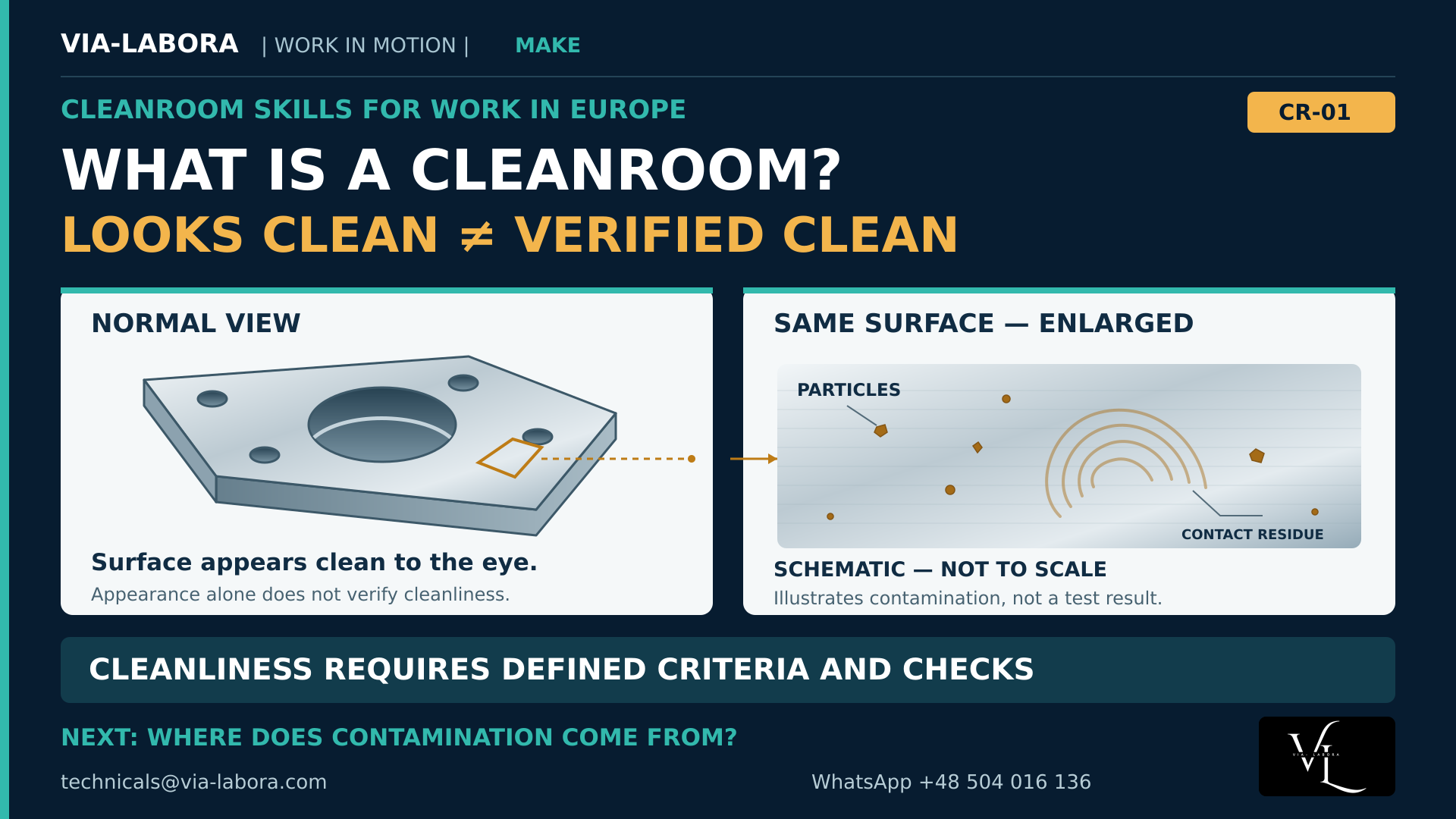
The board below introduces the central idea of this lesson: LOOKS CLEAN ≠ VERIFIED CLEAN.
To understand cleanroom work, we need to connect what we see with the product’s requirements, its handling history and the checks required by the process.
View the board at full size (opens a new tab) ↗
The enlarged view illustrates possible contamination. It is schematic, not to scale, and is not a test result. Whether a component is acceptable depends on the applicable requirements and required checks.
Series update: the original social board announced a different next topic. The current learning pathway continues with CR-02 — Cleanroom Classifications.
Situation from work
Two candidates describe their experience as “production work”. One packed finished products in a general manufacturing area. The other prepared precision components under controlled handling and cleaning instructions. Both backgrounds may be valuable, but they are not interchangeable. Before matching a person to a cleanroom role, understand what the environment protects, their tasks and the controls governing their work.
Who is this for?
Candidates exploring cleanroom work; production workers identifying transferable skills and training gaps; experienced operators explaining their work; employers, recruiters and team leaders distinguishing general production from controlled-environment experience.
What will you gain?
Candidates can understand the working environment, identify relevant experience and ask informed questions before accepting a role. Employers and partners gain shared language for contamination-sensitive work and the experience a position requires.
What the board is teaching you
The left panel shows how a component appears during ordinary observation. The right panel makes possible particles and contact residue visible through a conceptual illustration.
It does not prove that a particular component is contaminated. It explains why appearance alone cannot establish that all cleanliness requirements have been met.
The next question is not simply ‘Does it look clean?’ It is:
‘What requirements apply to this component, and what evidence does the process require before it can be used?’
A classified cleanroom supports contamination control. It does not automatically establish the acceptance status of every component inside it.
- What makes a cleanroom a controlled environment
- Why airborne cleanliness and component cleanliness are different
- How everyday behaviour can affect contamination control
WHY THIS MATTERS AT WORK
Imagine two components on a workbench. Both look clean. One has a small fibre on a sensitive surface; the other has a fingerprint where a later bonding operation will take place.
Depending on the product and process, these contaminants could affect performance, interfere with processing or lead to rejection. Looking clean is not enough to demonstrate that a component meets its cleanliness requirements.
Cleanroom work helps reduce these risks through a combination of environmental controls, suitable materials, defined working methods and trained people.
For an operator, this means that following the process is part of making a good product. Your work is judged by both what you produce and how you protect it during production.
LEARNING OBJECTIVES
After this lesson, you should be able to:
- Explain the purpose of a cleanroom in plain English.
- Distinguish a cleanroom from an ordinary clean production area.
- Identify examples of contamination sources and transfer pathways.
- Explain why clothing and operator behaviour are part of contamination control.
- Distinguish general principles from site-specific instructions.
- Describe an appropriate response when a cleanliness requirement is unclear.
CONNECTION TO PREVIOUS LEARNING
This is the first lesson in the Cleanroom Skills pathway. No previous cleanroom experience is required.
If you have worked in manufacturing before, start with one change in perspective: a surface that looks clean may still be unsuitable for a contamination-sensitive process.
CORE THEORY
WHAT IS A CLEANROOM?
In practical terms, a cleanroom is a room where airborne particle concentration is controlled and classified, and where its design and operation help control the introduction, generation and retention of particles.
Other conditions, such as temperature or humidity, may also be controlled when the process requires them.
A clean zone provides a defined space with controlled airborne particle cleanliness. It may protect a particular operation within a larger environment.
The word “controlled” matters. A cleanroom depends on specified requirements and evidence of performance, rather than appearance alone.
A clean production hall may be orderly, well maintained and regularly cleaned without being a classified cleanroom. Equally, clothing, white walls or modern equipment do not establish a room’s classification.
WHAT DOES A CLEANROOM PROTECT?
In many high-tech manufacturing settings, a central purpose is to protect the product or process from contamination.
Depending on the work, relevant contamination may include:
- Particles, such as dust, fibres or wear debris.
- Surface residues, such as oils or unwanted processing chemicals.
- Microorganisms, where biological contamination is relevant.
Different processes have different sensitivities. A control that is appropriate for one product may be insufficient or unnecessary for another.
Airborne particle classification does not, by itself, establish surface cleanliness, chemical cleanliness or sterility.
WHERE CAN CONTAMINATION COME FROM?
Potential sources include people, clothing, packaging, tools, equipment, materials and the production process itself.
Contamination may travel through the air or transfer by contact. For example, material on a glove can move to a tool, and then from the tool to a component.
This is why controlling the air alone is insufficient to protect every aspect of the work.
Conceptual example
A pathway can carry contamination to a sensitive feature. Contact does not necessarily cause a defect or rejection; outcomes depend on product requirements and conditions.
A CLEANROOM IS A WORKING SYSTEM
Effective contamination control brings several elements together:
- Facility and equipment: the environment supports the required conditions.
- People: trained personnel follow the rules for their tasks.
- Materials: items enter and are used through approved routes and methods.
- Methods: defined procedures govern the work.
- Monitoring: checks provide evidence about relevant conditions and performance.
Cleaning supports this system. It cannot compensate for every uncontrolled action.
Facility, people, materials, methods and monitoring work together to control contamination.
CLOTHING IS PART OF THE PROCESS
Cleanroom garments can help limit contamination released or transferred by people. Their role is therefore broader than personal protection.
Depending on the task, some items may also protect the wearer. However, a garment’s cleanroom function does not automatically make it suitable protection against a chemical, mechanical or other workplace hazard.
The required garments and the way they are put on, used and removed are defined by the site. There is no single gowning sequence suitable for every cleanroom.
IMPORTANT DISTINCTIONS
Cleanroom classification and job grade are different things. An ISO cleanroom class concerns airborne particle cleanliness. A company job grade describes a role or employment level.
Cleanroom and sterile are different concepts. A cleanroom should not be assumed to be sterile.
Contamination control and ESD control address different risks. ESD means electrostatic discharge. A process may need both, but meeting one set of requirements does not demonstrate compliance with the other.
Cleaning, assembly, inspection, measurement and documentation also have different purposes. They may work together within one production process, but they are not interchangeable tasks.
TECHNICAL TERMINOLOGY
A room with controlled and classified airborne particle concentration, designed and operated to limit particle contamination.
An environment in which specified conditions are managed for a particular purpose. The term alone does not establish an ISO cleanroom classification.
Unwanted matter or substances that may affect a product, process or environment.
A small piece of matter. Its relevance depends on factors such as size, material, location and process sensitivity.
Contamination carried in the air.
Contamination present on a surface.
Measures used to prevent or limit contamination and its transfer.
Putting on the garments required for a controlled area according to the applicable procedure.
A controlled document describing how a defined activity must be performed.
The ability to follow relevant history through recorded information, such as material identity, processing steps or inspection results.
A transfer of electrostatic charge that can damage sensitive electronic items. It is a separate topic later in this pathway.
STEP-BY-STEP EXPLANATION
How to understand the purpose of a cleanroom task
The following is a learning framework, not an entry, gowning or production procedure.
Step 1 — Identify what needs protection.
Ask what product, surface or process is sensitive. A critical optical surface may need different controls from an external housing.
Step 2 — Identify the relevant contamination risk.
Consider what could affect the work: particles, residues or another specified form of contamination. Use the process requirements rather than guessing.
Step 3 — Consider how contamination could reach it.
Possible pathways include airborne movement, direct contact and transfer between gloves, tools, packaging and parts.
Step 4 — Identify the defined controls.
These may include environmental controls, approved materials, garments, handling methods and limits on exposure.
Step 5 — Follow the instruction for your task.
Use the current approved procedure and work within your training and authorisation. Experience at a previous employer does not replace local instruction.
Step 6 — Recognise uncertainty and respond appropriately.
If an item’s cleanliness status or an instruction is unclear, avoid introducing it into the process. Follow the site’s reporting or escalation route. Do not invent a cleaning method or decide on your own that a potentially affected part is acceptable.
REALISTIC HIGH-TECH PRODUCTION EXAMPLES
Conceptual comparison: two similarly clean-looking precision components.
Required preparation and acceptance status confirmed.
Preparation or acceptance status not established.
Unknown status does not automatically mean contaminated or rejected. Follow the applicable site process to determine the next action.
These are illustrative scenarios, not instructions for a particular facility.
Example 1 — Optical assembly
A fibre lands on an optical surface before assembly. Depending on its position and the product requirements, it may interfere with performance or require rework.
Workplace lesson: contamination can matter because of where it is, even when the rest of the component appears clean.
Example 2 — Precision bonding
An operator touches a bonding surface with a glove that has contacted an unsuitable material. An unwanted residue may transfer to the surface and affect a later bonding step.
Workplace lesson: wearing gloves does not automatically keep every touched surface clean.
Example 3 — Material transfer
A delivery arrives in outer transport packaging. That packaging may carry contamination from storage and transport. Whether and how it can enter a controlled area depends on the approved transfer process.
Workplace lesson: an item’s route into the area is part of contamination control.
Example 4 — Electronic assembly
An electronic component requires both contamination controls and ESD controls.
Workplace lesson: a clean-looking workstation does not prove that electrostatic risks are controlled. Each requirement needs its own appropriate measures.
COMMON MISTAKES
“If I cannot see dirt, the part is clean.” Visual appearance alone cannot demonstrate compliance with all cleanliness requirements.
“The ventilation system will remove everything.” Air controls do not eliminate every source, surface residue or contact-transfer risk.
“Any gloves are suitable.” Suitability depends on the task, product, environment and applicable safety requirements.
“The cleanroom suit mainly protects me.” Cleanroom garments often serve an essential contamination-control function. Personal protection must also match the hazards.
“My previous workplace used this method, so I can use it here.” Local materials, products, equipment and approved procedures may differ.
“A higher job grade means a different ISO class.” Job grades and cleanroom classifications describe different things.
“If something may be contaminated, I should quickly wipe it.” An unapproved cleaning attempt may create further problems. Follow the defined response.
OPERATOR BEHAVIOUR / JOB CONTEXT
Cleanroom roles may involve cleaning, assembly, inspection, material handling or technical production support. Each role has its own training and authorisation requirements.
Across these roles, useful working habits include:
- Read and follow the instruction relevant to your task.
- Keep track of what has touched critical items and surfaces.
- Use only materials and tools approved for the operation.
- Follow local rules for movement, access and material transfer.
- Report suspected contamination or deviations promptly.
- Record information accurately when the process requires it.
- Ask when you do not understand a requirement.
Reliable operators do not need to guess every technical answer. They need to recognise the limits of their knowledge and use the correct support route.
This lesson provides foundational understanding. Practical work requires the employer’s training, task authorisation and site-specific instructions.
TRY IT YOURSELF
Exercise — Follow the contamination pathway
Read this scenario:
An operator wearing cleanroom gloves picks up an outer transport carton. The operator then reaches towards an exposed precision component. You do not know whether that carton was approved for the area or whether the glove-contact sequence is permitted.
Answer these questions:
1. What is the possible contamination source? 2. What is the possible transfer pathway? 3. Which item may need protection? 4. What information is missing? 5. What should happen before the operator continues?
Suggested response:
The carton is a potential source. The gloves could transfer contamination from the carton to the component. The exposed component, particularly any critical surface, may need protection.
Missing information includes the approved packaging route, handling requirements and glove procedure.
Before continuing, the operator should follow the applicable instruction or seek clarification through the local support route. If contact has already occurred, the potential deviation should be handled under the site’s process. This scenario alone does not establish that the component must be accepted, cleaned or rejected.
KNOWLEDGE CHECK
KEY TAKEAWAYS
- A cleanroom is a controlled working environment, not simply a tidy room.
- Contamination can affect a product without being obvious to the naked eye.
- People, equipment, materials and processes can introduce or transfer contamination.
- Facility controls and operator behaviour work together.
- Garments can protect the process as well as serving any specified personal-protection role.
- Air classification, surface cleanliness, sterility, ESD and job grades are different concepts.
- Follow the site’s approved instructions and ask when requirements are unclear.
REFERENCES AND SCOPE
This lesson provides introductory education for contamination-sensitive manufacturing. Examples are illustrative and do not replace a facility’s approved procedures.
ISO 14644-1:2015 — Classification of air cleanliness by particle concentration ↗
ISO 14644-5:2025 — Operations ↗
These references identify the relevant standards and their scope. This lesson does not reproduce their full requirements or demonstrate compliance with them.
CR-01 — Think in Contamination Pathways
A learning worksheet for understanding cleanroom work.
This worksheet supports learning. It is not an approved operating procedure, entry checklist or authorisation to perform a task.
Completed example
- Product or process
- Precision optical assembly.
- Sensitive feature
- An exposed optical surface.
- Potential source
- A fibre from unsuitable wiping material.
- Transfer pathway
- Contact during wiping.
- Possible effect
- Interference with optical performance, depending on the product requirements.
- Instruction to check
- The approved material and cleaning instruction for that operation.
- Question to ask
- Which wiping materials and methods am I authorised to use?
VIA-LABORA Academy | CR-01 | Learning aid — follow site-specific procedures.
Next: CR-02 — Cleanroom Classifications
Now that you understand why cleanrooms exist, the next lesson explains how airborne particle cleanliness is classified—and what a classification does and does not tell you about the workplace.
You will also learn why an ISO cleanroom class must never be confused with a company job grade.
Continue learning
What depends on the site SOP?
The facility defines garments, entry and handling methods, approved materials, component status, deviation response and task authorisation. Apply the current site instructions and ask the designated person when requirements are unclear.
Use it in a technical interview
Describe the product, your actual task and the controls followed. If true: “I prepared precision components using approved cleaning and handling instructions, completed records and reported unclear component status.” If entering from general production: “My experience is in [actual task]; I understand that cleanroom work adds contamination controls and I would need training in your site procedures.” Do not invent a classification, authorisation or task.
Use it with your team
Discuss which product features are sensitive, which tasks need prior practical experience, which skills can be taught at induction, how component status is identified and who resolves uncertainty. Informal team agreements do not replace approved procedures.
For candidates
Describe your actual production tasks, products, training and responsibilities. Explain controlled-environment experience specifically, or identify transferable skills and training needs. Ask about current opportunities or the Technical Talent Pool; requirements and availability vary.
technicals@via-labora.com · WhatsApp +48 504 016 136
For employers and partners
Discuss the product context, tasks and essential competencies. Distinguish general production experience from controlled cleaning, handling, assembly, inspection and documentation.