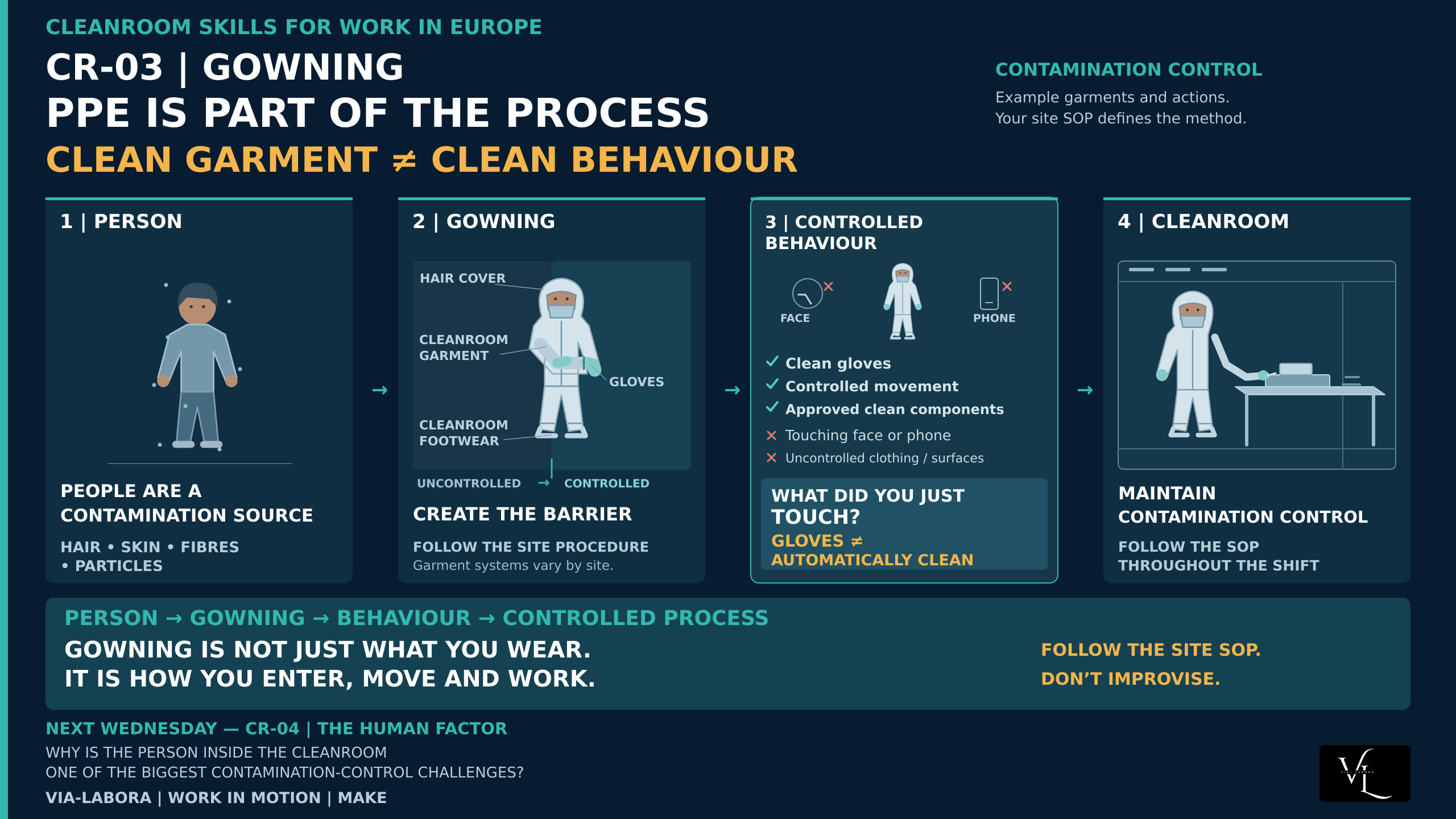
CLEAN GARMENT ≠ CLEAN BEHAVIOUR
In CR-01, we learned why contamination control matters. In CR-02, we learned that an ISO class describes airborne particle cleanliness—not a complete working method.
Now we turn to the person entering that environment.
Cleanroom gowning is more than putting on a suit. It is a controlled activity intended to help limit contamination from people and their clothing.
The garment system matters. How it is handled matters. What the operator touches afterwards matters too.
A clean garment cannot compensate for uncontrolled behaviour.
View full-size graphic (opens a new tab) ↗
- Explain why garments and correct handling support contamination control.
- Distinguish product protection from personal protection.
- Recognise contact transfer and follow the site procedure when uncertain.
WHY THIS MATTERS AT WORK
Imagine an operator who has put on the required garments correctly.
Before handling a precision component, the operator touches a personal phone and then reaches towards a sensitive surface.
The garments may still look correct, but the contact has introduced a possible contamination pathway.
Now imagine another operator whose garment sleeve contacts an uncontrolled surface during gowning. Completing the remaining dressing steps does not automatically resolve that event.
These examples explain the central question on the board:
WHAT DID YOU JUST TOUCH?
Good gowning protects the intended condition of the garment system. Good working behaviour helps maintain that control during the task.
LEARNING OBJECTIVES
After this lesson, you should be able to:
- Explain why cleanroom garments are part of contamination control.
- Distinguish product protection from personal protection.
- Explain why gowning technique matters.
- Recognise how gloves and garment surfaces can transfer contamination.
- Distinguish a general principle from a site-specific gowning method.
- Respond appropriately when garment condition or contact history is uncertain.
PREREQUISITES / CONNECTION TO PREVIOUS LESSONS
Recommended previous lessons:
CR-01 — What Is a Cleanroom — and Why Does It Matter?
CR-02 — Cleanroom Classifications
Remember:
LOOKS CLEAN ≠ VERIFIED CLEAN.
ISO CLASS DOES NOT DEFINE A COMPLETE WORKING PROCEDURE.
This lesson explains gowning principles. It does not provide a dressing sequence or replace supervised site training.
CORE THEORY
1. PERSON — WHY GARMENTS ARE NEEDED
People can release or transport particles through skin, hair, clothing and footwear.
This does not mean the person is visibly dirty. Normal human activity can introduce contamination that matters to a sensitive process.
Cleanroom garment systems help limit the release or transfer of that contamination.
They do not sterilise the wearer, eliminate every particle or make every action acceptable.
The detailed human-factor mechanisms are developed in CR-04.
2. GOWNING — THE METHOD MATTERS
Gowning means putting on the required garments using the applicable procedure.
The activity includes protecting the garments from inappropriate contact while they are handled and fitted.
A suitable garment can become unsuitable for its intended use if it is damaged, handled incorrectly or exposed to contamination.
This is why selecting the right item is only part of the task.
The operator also needs to know:
- Which items are approved for the area and operation.
- How their required status is established.
- How to handle and put them on.
- How the different items must fit together.
- What to do if something goes wrong.
The procedure defines these details.
3. PPE AND CLEANROOM GARMENTS — RELATED BUT DIFFERENT FUNCTIONS
PPE means personal protective equipment. Its purpose is to protect the wearer against specified hazards.
Cleanroom garments have a contamination-control function: helping protect the product, process or environment from contamination associated with people.
Some items can serve both functions when appropriately selected. However:
A garment suitable for contamination control is not automatically suitable protection against chemicals, heat, cuts or other hazards.
Likewise, equipment that protects the worker is not automatically suitable for a contamination-sensitive process.
The lesson title uses the familiar term PPE. In practice, distinguish the protective function of each item rather than assuming all cleanroom clothing is hazard-protective PPE.
Neither product protection nor worker protection should be treated as optional.
Contamination-control requirements
Hazard-protection requirements
↓ Both inform the selection ↓
Use the approved system for the task.
Items may serve different functions; check suitability for the task.
4. THE GARMENT SYSTEM WORKS AS A SYSTEM
Depending on the site, examples may include head coverings, garments, gloves, footwear or footwear covers, masks and other specified items.
The board shows examples, not a mandatory set for every cleanroom.
Fit and the way items meet each other can influence coverage and performance. The required arrangement must come from the approved method.
More layers do not automatically mean better control. An unapproved combination can affect fit, movement, comfort or protective performance.
Do not add, substitute or rearrange items on your own.
5. BOUNDARIES HELP CONTROL TRANSFER
Gowning areas may use defined zones, benches, storage arrangements or other boundaries to manage movement and contact.
Their layout and meaning are site-specific.
The “uncontrolled → controlled” illustration on the board represents a transition in contamination control. It does not mean that every facility uses the same physical arrangement.
Learn which surfaces and locations have which permitted uses.
“Clean” is always relative to a defined requirement. It does not mean a surface is contamination-free.
6. GLOVES ARE NOT AUTOMATICALLY CLEAN
A glove can become a transfer pathway.
For example:
Uncontrolled surface → glove → sensitive component.
A glove may also be damaged or unsuitable for the material being handled.
The approved procedure determines glove selection, use, checks and any required replacement or treatment.
Do not assume that spraying, wiping or disinfecting a glove will resolve every contact event. Such actions require an approved method and compatible materials.
Do not improvise a chemical, concentration, contact time or replacement interval.
Possible transfer pathway — conceptual illustration.
A possible pathway, not a measured result or automatic rejection. Follow the approved response.
7. CONTROLLED BEHAVIOUR CONTINUES AFTER GOWNING
Completing gowning is not the end of contamination control.
During work, consider what the hands, sleeves and garment surfaces contact.
Unnecessary contact with the face, personal items or uncontrolled surfaces can create transfer risks. Garments can also be affected by damage or changes in fit.
The board’s phone symbol illustrates a risk from uncontrolled contact. Rules for approved devices and their handling depend on the site.
If a garment needs adjustment, follow the local method rather than adjusting it and immediately resuming sensitive handling.
We develop wider movement and behaviour topics in CR-04.
8. WHAT IF SOMETHING GOES WRONG?
Examples include:
- A garment contacting an uncontrolled surface.
- A glove contacting the face or a personal item.
- A tear or other damage.
- An item with unclear status.
- An arrangement that does not match the training.
Do not assume that finishing the gowning sequence or making a quick adjustment resolves the issue.
Avoid further uncontrolled contact and follow the defined response.
Depending on the situation and procedure, that response may involve clarification, replacement, approved treatment or another specified action.
This lesson does not determine which response applies.
If a product may already have been affected, report the event through the applicable process. Do not independently accept, clean or reject the product.
9. THE SAME ISO CLASS DOES NOT MEAN THE SAME GOWNING METHOD
Facilities with the same class may have different products, processes, hazards and garment systems.
A procedure learned elsewhere is useful experience, but it does not replace local training.
ISO 14644-5 includes gowning within the wider organisation of cleanroom operations. A generic article does not define a compliant method for every facility.
TECHNICAL TERMINOLOGY
Gowning:
Putting on the required garments using the applicable procedure.
Garment system:
The selected clothing and associated items used together for the defined task and environment.
Contamination-control garment:
A garment intended to help limit contamination associated with the wearer.
PPE:
Personal protective equipment selected to protect against specified hazards.
Contact transfer:
Movement of contamination through contact between surfaces.
Garment integrity:
The physical condition needed for the item to perform its intended function.
Controlled boundary:
A defined separation used to manage movement or contact within the site’s arrangements.
SOP / Work Instruction:
The approved document defining applicable work requirements.
Doffing / de-gowning:
Removing garments using the applicable method. Detailed exit and removal arrangements are addressed with site training and CR-05.
STEP-BY-STEP EXPLANATION
HOW TO THINK ABOUT GOWNING
The following is a reasoning framework, not a dressing sequence. Its numbering does not specify the order for putting on garments.
1 — KNOW THE REQUIREMENTS
Identify the area, task and current instruction.
Confirm that you have the required training.
2 — IDENTIFY THE APPROVED ITEMS
Use the specified garment system and the required item status.
Do not substitute a visually similar item.
3 — PROTECT THE ITEMS DURING HANDLING
Understand which contacts the procedure permits and how the area’s boundaries work.
4 — FOLLOW THE TAUGHT METHOD
Use the site’s sequence, handling technique and fit arrangements.
5 — COMPLETE THE REQUIRED CHECKS
The site defines checks for fit, coverage, condition and completion. Do not invent an inspection checklist from this article.
6 — MAINTAIN CONTROL DURING WORK
Pay attention to contact history, garment condition and task changes.
7 — USE THE CORRECT RESPONSE TO UNCERTAINTY
Follow the local reporting or correction process before continuing affected work.
REALISTIC HIGH-TECH PRODUCTION EXAMPLES
These are educational scenarios, not operating instructions.
EXAMPLE 1 — THE SLEEVE AND THE BENCH
During gowning, an operator’s sleeve contacts a surface not approved for that contact.
The garment still looks clean.
Lesson:
Appearance does not resolve uncertainty about its condition. Use the defined response.
EXAMPLE 2 — THE PHONE AND THE COMPONENT
An operator handles an uncontrolled personal phone and then prepares to touch a precision assembly.
Lesson:
A glove can connect two otherwise separate surfaces. The relevant question is what happened after the glove was put on.
EXAMPLE 3 — THE TEAR
An operator notices damage to a garment while working.
Lesson:
Correct initial gowning does not guarantee that the garment remains suitable throughout the shift. Follow the local response and report any potentially affected work.
EXAMPLE 4 — THE FAMILIAR METHOD
A new employee follows a gowning method from a previous employer, although the new site’s procedure differs.
Lesson:
Experience is not permission to substitute procedures.
EXAMPLE 5 — PRODUCT CONTROL AND WORKER PROTECTION
A cleaning task needs both contamination control and protection against a specified chemical hazard.
Lesson:
“Cleanroom suitable” does not by itself establish chemical protection. Use the items approved for both the process and its hazards.
COMMON MISTAKES
“I am fully dressed, so I am ready for any cleanroom task.”
Garments do not replace task training or authorisation.
“The glove looks clean.”
Appearance does not establish its contact history or suitability.
“All cleanrooms use the same gowning sequence.”
They do not. Follow the site method.
“More layers are always better.”
Only use approved combinations.
“A quick spray fixes any contact.”
Treatment is not a universal remedy. Follow the approved response.
“Cleanroom garments automatically protect against every hazard.”
Contamination-control suitability and personal protection must both be assessed.
“A small handling mistake does not need reporting.”
Follow the reporting criteria. Accurate information enables the correct assessment.
OPERATOR BEHAVIOUR / REAL JOB CONTEXT
Employers need more than the statement “I wore a cleanroom suit”.
Useful experience includes understanding:
- Why the garment system was required.
- Which procedure you followed.
- How contacts and boundaries were controlled.
- What checks you performed.
- How you responded to damage or uncertainty.
- Which tasks you were authorised to carry out.
A truthful experience statement might be:
“I followed the site’s gowning procedure, completed the required checks and maintained glove-contact awareness during precision assembly. I reported garment damage and uncertain contact events through the defined route.”
Do not claim competence in garment systems or methods you have not used.
TRY IT YOURSELF
SCENARIO 1 — IT STILL LOOKS CLEAN
Your garment contacts an uncontrolled surface during gowning. There is no visible mark.
Can you assume it is acceptable?
Show suggested answer
No. Appearance does not establish that the contact was acceptable. Follow the site’s response before continuing.
SCENARIO 2 — WHAT DID YOU JUST TOUCH?
You adjust a face covering, then prepare to handle an exposed technical component.
What should you consider?
Show suggested answer
Consider whether the contact changed the glove’s suitability for the next task. Follow the specified response rather than assuming adjustment is irrelevant or inventing a glove treatment.
SCENARIO 3 — SAME CLASS, DIFFERENT GARMENTS
Your new employer uses a different garment system from your previous workplace, despite the same stated ISO class.
Which method should you follow?
Show suggested answer
The new site’s approved method and training.
SCENARIO 4 — AN UNCLEAR ITEM
A garment is available, but you cannot establish its required status.
Should you use it because it appears unused?
Show suggested answer
No. Establish its status through the approved process. “Looks unused” is not the same as “approved for use”.
KNOWLEDGE CHECK
1. Why are cleanroom garments used?
Show answer and explanation
To help limit contamination associated with people. Any personal-protection function depends on the item’s selection and intended use.
2. Does wearing gloves prevent contamination transfer?
Show answer and explanation
No. Gloves can transfer contamination between surfaces.
3. Can you derive a complete gowning sequence from an ISO class number?
Show answer and explanation
No. Use the site’s approved procedure.
4. Why does technique matter if the garment itself is suitable?
Show answer and explanation
Handling and fitting can affect the garment’s condition and performance.
5. Is glove disinfection a universal response to uncontrolled contact?
Show answer and explanation
No. Required actions depend on the approved method, materials and event.
6. What should you do when damage or uncertain contact may have affected work?
Show answer and explanation
Avoid further uncontrolled contact and follow the defined correction and reporting process.
KEY TAKEAWAYS
- Clean garment ≠ clean behaviour.
- Gowning is part of contamination control.
- Product protection and wearer protection are different functions.
- Suitable items still require suitable handling and use.
- Gloves carry a contact history.
- Garment systems and sequences vary by site.
- Follow the SOP. Do not improvise.
Gowning Awareness — Questions to Confirm With Your Trainer
- Which area and task am I being trained for?
- Which garment system is approved?
- How is the required item status identified?
- Which handling contacts and boundaries apply?
- Where is the current gowning procedure?
- Which completion checks are required?
- What should I do after uncertain contact or garment damage?
- How are adjustments and interruptions handled?
- Who should I contact if I am unsure?
CLEAN GARMENT ≠ CLEAN BEHAVIOUR.
WHAT DID YOU JUST TOUCH?
FOLLOW THE SITE SOP.
Training discussion aid. Not a gowning sequence, entry checklist or authorisation to work.
References and scope
ISO 14644-5:2025 — Cleanrooms and associated controlled environments — Part 5: Operations.
The official ISO description identifies gowning and personnel training as elements of cleanroom operations. This lesson does not reproduce the full standard or establish compliance.
Item suitability, protective performance, compatibility and use must be checked against approved site requirements and relevant manufacturer instructions.
No universal garment list, dressing sequence, glove-treatment method, replacement interval or environmental parameter is prescribed here.
Next in the series
Garments help control contamination, but the person wearing them remains part of the process. CR-04 explores how everyday actions, habits and movement can affect contamination control.
Detailed entry, exit and garment-removal arrangements remain within the scope of CR-05 and site training.