Know your process. Describe your skills.
“I work with CNC machines.”
That is a useful starting point, but it leaves important questions unanswered.
Which process do you work with? Which machine do you use? Do you run an established production job, prepare the machine for new work, create programs, or combine these responsibilities?
CNC and metalworking roles share a concern for drawings, measurements, and quality. However, the processes and daily tasks can be very different.
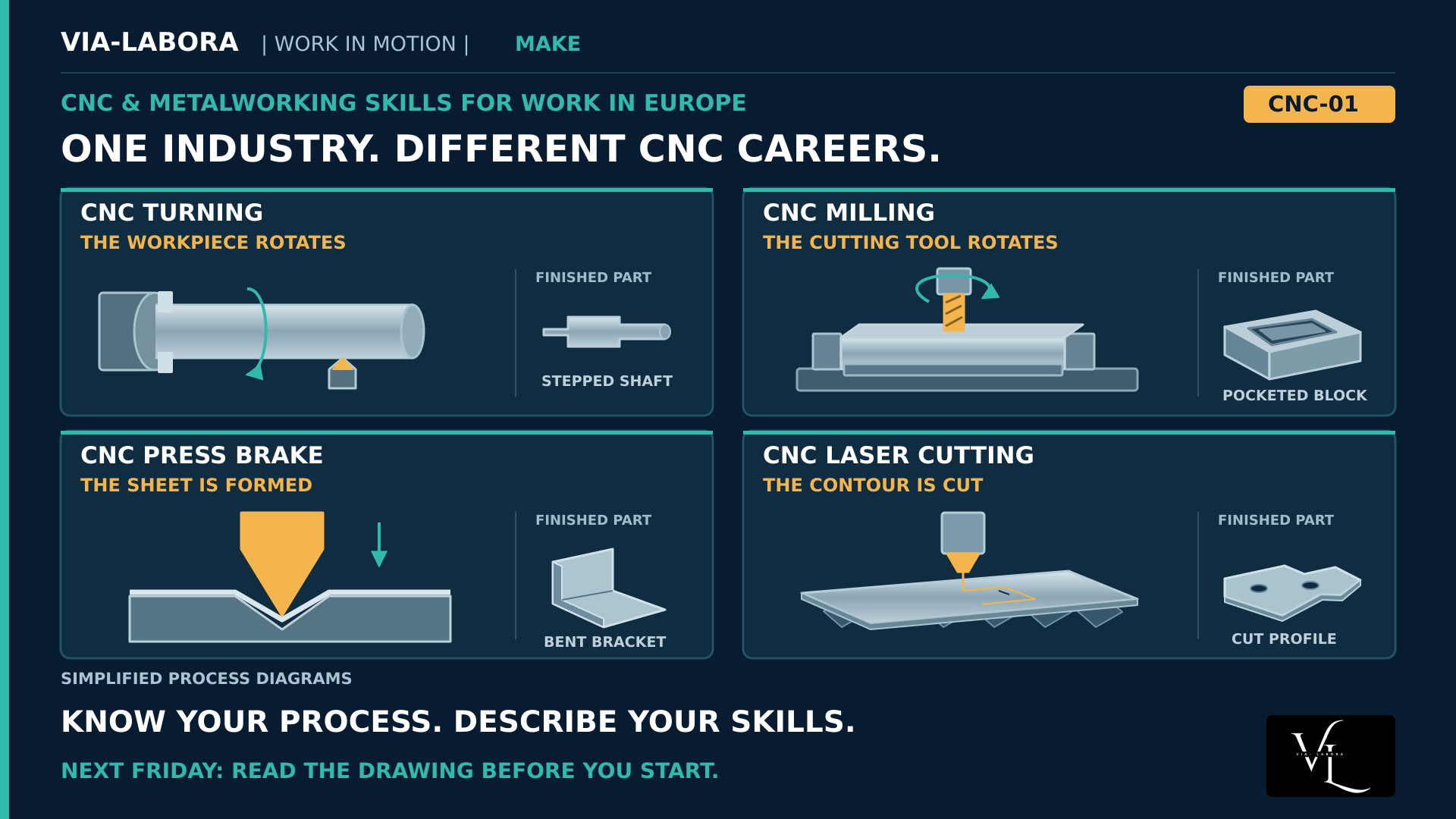
This lesson introduces four pathways — TURN, MILL, BEND, and CUT — and explains how to describe your experience accurately.
View full-size graphic (opens a new tab) ↗
- The difference between turning, milling, bending and cutting
- How machine processes differ from control systems
- What information helps an employer understand your experience
Situation from Work
During an interview, a candidate says:
“I have three years of CNC experience.”
The interviewer asks:
“Turning or milling? Did you run approved jobs, prepare new setups, or create programs? Which inspections did you perform?”
The candidate has useful experience, but the first statement did not explain it.
A stronger description might be:
“I operate a CNC lathe during approved production runs. I perform assigned diameter and length checks and record the results. A setter prepares new jobs and handles program changes.”
Specific tasks make competence easier to understand.
Who Is This For?
This lesson is for:
- People considering a first manufacturing role.
- CNC and metalworking candidates preparing for interviews.
- Operators choosing their next learning goal.
- Experienced workers moving between companies or specialisations.
- Employers and team leaders defining job responsibilities.
No previous CNC experience is required.
What Will You Gain?
You will be able to explain:
- Which manufacturing process you know.
- What type of machine you have used.
- Which control system you have worked with, if known.
- What you perform independently.
- Where you need support or further training.
You will also understand why a familiar job title does not guarantee identical responsibilities in another workplace.
Learning Objectives
By the end of this lesson, you should be able to:
- Explain what CNC means.
- Recognise the basic principles of turning, milling, bending, and laser cutting.
- Separate process, machine, control, and responsibility.
- Distinguish common technical roles.
- Describe competence through demonstrated tasks.
- Recognise the limits of your knowledge and authorisation.
- Choose a practical next learning goal.
Technical Foundation
CNC describes a method of control
CNC stands for Computer Numerical Control.
A CNC system executes programmed machine movements and functions. The machine’s construction, equipment, and capabilities determine which manufacturing operations it can perform.
CNC is not the name of one manufacturing process.
People still need to interpret requirements, prepare the work, verify the result, and respond to problems.
Four pathways in this series
| Pathway | Basic principle | Example in the anchor visual |
|---|---|---|
| TURN | In conventional turning, the workpiece rotates while a cutting tool removes material. | Stepped shaft |
| MILL | A rotating cutting tool removes material through controlled movement relative to the workpiece. | Pocketed block |
| BEND | Tooling changes the shape of sheet metal through plastic deformation. | Bent bracket |
| CUT | The initial focus of this series is laser cutting of sheet-metal contours. | Cut profile |
Some machines combine processes. For example, suitable turn-mill equipment can perform turning and milling operations.
The four pathways help organise learning; they do not describe every machine configuration.
TURN — CNC turning
THE WORKPIECE ROTATES.
Turning commonly produces rotational features such as cylindrical surfaces, shoulders, faces, grooves, and bores.
Typical parts include shafts and bushings.
Practical competence may involve workholding, tools, feature requirements, dimensional checks, and recognising changes in the process.
These skills must be understood in the context of the actual machine and assigned duties.
MILL — CNC milling
THE CUTTING TOOL ROTATES.
In milling, the rotating tool and workpiece move relative to each other. Depending on the machine, movement can involve the tool, the workpiece, or both.
Typical features include faces, pockets, slots, and contours. Machining centres may also perform operations such as drilling.
Relevant skills can include workpiece positioning, tooling, feature interpretation, and inspection.
BEND — CNC press-brake bending
THE SHEET IS FORMED.
A press brake forms sheet metal using tooling, commonly an upper punch and lower die.
The material undergoes plastic deformation: its shape changes permanently.
Relevant skills can include material and thickness identification, tooling knowledge, part orientation, bending sequence, and checking the finished geometry.
A finished bracket and its flat blank represent different stages of manufacture.
CUT — CNC laser cutting
THE CONTOUR IS CUT.
A focused laser beam supplies energy to the cutting zone. Common industrial sheet-metal processes also use cutting gas.
The machine follows programmed contours to separate profiles and openings from the sheet.
Relevant skills can include material identification, job preparation, approved process information, cut completeness, and edge-quality checks.
Other cutting technologies exist. Laser-cutting experience should not automatically be presented as competence in plasma, waterjet, or sawing.
One product can use several processes
A bracket may first be cut from sheet and then bent.
Cutting creates the blank. Bending creates the formed shape.
A shaft may require turning and additional milling.
The approved manufacturing route determines which operations are needed.
Terminology EN / PL
| English | Polski | Meaning |
|---|---|---|
| Manufacturing process | Proces wytwarzania | Method used to transform or separate material |
| Workpiece | Przedmiot obrabiany | Item undergoing an operation |
| Stock / blank | Materiał wyjściowy / półfabrykat | Starting material for an operation |
| Turning | Toczenie | Machining associated primarily with a rotating workpiece |
| Milling | Frezowanie | Machining using a rotating cutting tool |
| Press-brake bending | Gięcie na prasie krawędziowej | Forming sheet metal using bending tooling |
| Laser cutting | Cięcie laserowe | Separating material using a focused laser beam |
| CNC control | Sterowanie CNC | System executing programmed machine movements and functions |
| Setup | Ustawienie / przygotowanie maszyny | Preparation for a particular job |
| Inspection | Kontrola | Checking whether requirements are met |
| Authorisation | Upoważnienie | Permission to perform a defined task |
| Nonconforming part | Detal niezgodny | Part that does not meet a specified requirement |
| Handover | Przekazanie pracy | Transfer of production status and relevant information |
Process Explanation
To understand a CNC job, answer four separate questions.
| Category | Question | Example |
|---|---|---|
| Process | What happens to the material? | Turning |
| Machine | What equipment performs the work? | A specified CNC lathe |
| Control | What system controls the machine? | The installed control model and version |
| Responsibility | What does the person do? | Runs approved jobs and performs assigned inspections |
PROCESS — what happens to the material?
MACHINE — what equipment performs the work?
CONTROL — what system controls the machine?
RESPONSIBILITY — what does the person do?
Illustrative example, not an assessment of a real person.
Then describe your independence:
- Performed independently within your authorisation.
- Performed with support.
- Observed but not performed.
- Not yet learned.
These descriptions communicate different levels of experience.
Time spent in a job is useful information, but it does not replace evidence of actual tasks.
Worked Example
Two people with the same job title
Alex and Sam are both called CNC Operators.
Alex runs an approved milling job, performs assigned checks, and reports deviations.
Sam performs those tasks and also prepares new jobs within an authorised setup role.
Their titles match. Their responsibilities differ.
A useful comparison asks:
- Which process and machines do they know?
- Which tasks have they demonstrated?
- Which decisions can they make independently?
- What support and approval are required?
Neither person’s competence should be inferred from the title alone.
This also works in reverse: different job titles may cover similar tasks in different companies.
Control / Process Differences
TURN, MILL, BEND, and CUT describe process pathways.
FANUC, SINUMERIK, HEIDENHAIN, and MAZATROL identify control systems or families encountered in CNC manufacturing.
These are separate categories.
Knowing a control family does not automatically establish competence on every machine using it.
The machine model, control generation, software, installed options, machine-builder integration, and workplace instructions matter.
A clear experience statement can include both:
“CNC turning on a specified lathe with a specified control; approved production operation and assigned inspection.”
Control-specific functions and programming belong to later lessons.
Common Mistakes
| Mistake | Better understanding |
|---|---|
| “FANUC means turning.” | The control and process are different categories. |
| “Every operator creates programs.” | Confirm the actual duties. |
| “An operator only presses Start.” | Operation can include monitoring, inspection, records, and reporting. |
| “I know this control, so I know every machine using it.” | Machine-specific competence is still required. |
| “Laser cutting and bending are the same skill.” | They are different processes. |
| “Watching a setup means I can perform it independently.” | Observation and demonstrated competence are different. |
| “Programming is the only valuable career direction.” | Setup, advanced operation, inspection, and other specialisations also matter. |
| “If I can change a value, I am allowed to change it.” | Ability and authorisation are separate. |
Practical Exercise
Exercise 1 — Identify the process and role
For each situation, identify the process, main responsibility, and one missing detail.
A. Marta runs approved shaft production on a CNC lathe and records assigned measurements. Another person prepares new jobs.
B. Adam prepares workholding and tooling for an aluminium plate on a machining centre.
C. Ewa develops a bending sequence for a specified press brake, considering available tooling and interference.
D. Piotr runs approved laser-cutting jobs and reports incomplete cuts.
Show suggested answers / Pokaż odpowiedzi
| Person | Process | Main responsibility | Question to clarify |
|---|---|---|---|
| Marta | TURN | Operation | Which adjustments is she authorised to make? |
| Adam | MILL | Setup | Who verifies and releases the setup? |
| Ewa | BEND | Programming / process preparation | How is the sequence verified? |
| Piotr | CUT — laser | Operation | Which inspections and production-control actions are assigned? |
The descriptions do not identify the control brand.
Exercise 2 — Improve the statement
Rewrite:
“I have CNC experience and work independently.”
Use:
PROCESS + MACHINE / CONTROL + TASKS + INDEPENDENCE
Example:
“I run approved CNC milling jobs on a machining centre and perform assigned dimensional checks. A setter prepares new jobs.”
Add machine and control details only when you know them.
Exercise 3 — Map your next step
Write:
- One task you perform independently.
- One task you perform with support.
- One task you have only observed.
- One task you want to learn.
- The supervised practice or training needed.
“Not yet performed” is an accurate answer.
Knowledge Check
What does CNC mean?
Show answer / Pokaż odpowiedź
Computer Numerical Control.
Is milling a control system?
Show answer / Pokaż odpowiedź
No. It is a manufacturing process.
What rotates in conventional turning?
Show answer / Pokaż odpowiedź
The workpiece.
What rotates during milling?
Show answer / Pokaż odpowiedź
The cutting tool; controlled movement relative to the workpiece produces the feature.
What is the basic difference between bending and cutting?
Show answer / Pokaż odpowiedź
Bending changes shape through deformation; cutting separates material.
Does the title CNC Operator prove programming competence?
Show answer / Pokaż odpowiedź
No.
What information describes experience more clearly?
Show answer / Pokaż odpowiedź
Process, machine/control, demonstrated tasks, and independence.
What should you do when a change is outside your authorisation?
Show answer / Pokaż odpowiedź
Follow the workplace procedure and obtain support from the responsible person.
Use It in a Technical Interview
Prepare a specific example.
“My main process is turning. I run approved production jobs, inspect the assigned features, and record results. I report deviations to the setter. I have assisted with tool changes but have not yet prepared a complete new setup independently.”
This explains strengths and development needs without overstating experience.
If you also set or program, describe a real example and the verification or approval involved.
Use It With Your Team
When introducing a person to a job, establish:
- The process and machine.
- The tasks assigned.
- The checks required.
- The changes they may make.
- The issues they must escalate.
- The person who provides support.
- The conditions for working independently.
Use the workplace’s controlled training and authorisation records.
Key Takeaways
- CNC describes a method of control.
- TURN, MILL, BEND, and CUT are different process pathways.
- Process, machine, control, and responsibility must be distinguished.
- Job titles vary between workplaces.
- Competence is demonstrated through tasks.
- Technical roles can overlap without becoming identical.
- Career development has several directions.
- Know your process. Describe your skills.
CNC Career & Skills Map
Part A — My working environment
Part B — My demonstrated skills
| Task | Independently | With support | Observed only | Not yet performed | Evidence |
|---|---|---|---|---|---|
| Run an approved job | |||||
| Perform assigned inspections | |||||
| Record and report results | |||||
| Prepare a new setup | |||||
| Create or modify a program | |||||
| Another process-specific task |
Part C — My next learning goal
Do not calculate a universal CNC level. Assess competence by process, machine, task and independence.
Example profile: turning
Run approved jobs: independently
New setup: with support
Programming: not yet performed
Illustrative example, not an assessment of a real person.
CNC-01 — Jedna branża. Różne ścieżki zawodowe CNC.
ZNAJ SWÓJ PROCES. OPISZ SWOJE UMIEJĘTNOŚCI.
„Pracuję na CNC”.
To punkt wyjścia. Aby zrozumieć Twoje doświadczenie, trzeba również poznać proces, maszynę, wykonywane zadania i poziom samodzielności.
Toczenie, frezowanie, gięcie na prasie krawędziowej oraz cięcie laserowe należą do szeroko rozumianej produkcji przemysłowej. Różnią się wyposażeniem, sposobem pracy i wymaganymi umiejętnościami.
Ta lekcja pomaga rozpoznać te różnice i precyzyjnie opisać doświadczenie.
Sytuacja z pracy
Podczas rozmowy kandydat mówi:
„Mam trzy lata doświadczenia w CNC”.
Rekruter pyta:
„Toczenie czy frezowanie? Obsługiwałeś gotowe zlecenia, przygotowywałeś ustawienia czy tworzyłeś programy? Jakie kontrole wykonywałeś?”
Kandydat ma wartościowe doświadczenie, ale pierwsze zdanie go nie wyjaśniało.
Dokładniejszy opis:
„Obsługuję tokarkę CNC podczas zatwierdzonej produkcji. Wykonuję przypisane pomiary średnic i długości oraz zapisuję wyniki. Nowe zlecenia przygotowuje ustawiacz, który odpowiada również za zmiany programu”.
Konkretne zadania ułatwiają ocenę kompetencji.
Dla kogo jest ta lekcja?
Dla:
- Osób rozważających pierwszą pracę w produkcji.
- Kandydatów przygotowujących się do rozmowy technicznej.
- Operatorów wybierających następny cel nauki.
- Doświadczonych pracowników zmieniających zakład lub specjalizację.
- Pracodawców i liderów określających odpowiedzialność stanowisk.
Wcześniejsze doświadczenie CNC nie jest wymagane.
Co zyskasz?
Nauczysz się wyjaśniać:
- Jaki proces znasz.
- Na jakiej maszynie pracowałeś.
- Jakie sterowanie obsługiwałeś, jeśli je znasz.
- Co wykonujesz samodzielnie.
- Gdzie potrzebujesz wsparcia lub szkolenia.
Zrozumiesz również, dlaczego ta sama nazwa stanowiska może oznaczać różne obowiązki.
Cele nauki
Po lekcji potrafisz:
- Wyjaśnić znaczenie CNC.
- Rozpoznać podstawy toczenia, frezowania, gięcia i cięcia laserowego.
- Oddzielić proces, maszynę, sterowanie i odpowiedzialność.
- Rozróżnić podstawowe role techniczne.
- Opisać kompetencje przez wykonane zadania.
- Rozpoznać granice wiedzy i upoważnienia.
- Wybrać praktyczny następny cel nauki.
Podstawy techniczne
CNC określa sposób sterowania
CNC oznacza Computer Numerical Control — komputerowe sterowanie numeryczne.
System CNC realizuje zaprogramowane ruchy i funkcje maszyny. Konstrukcja, wyposażenie i możliwości maszyny określają dostępne operacje.
CNC nie jest nazwą jednego procesu produkcyjnego.
Ludzie nadal muszą rozumieć wymagania, przygotować pracę, sprawdzić rezultat i reagować na problemy.
Cztery ścieżki serii
| Ścieżka | Podstawowa zasada | Przykład na planszy |
|---|---|---|
| TURN | W podstawowym przypadku toczenia obraca się przedmiot, a narzędzie usuwa materiał. | Wałek stopniowany |
| MILL | Obracające się narzędzie usuwa materiał przez kontrolowany ruch względem przedmiotu. | Blok z kieszenią |
| BEND | Narzędzia trwale zmieniają kształt blachy przez odkształcenie plastyczne. | Zgięty wspornik |
| CUT | Początkowy zakres serii obejmuje laserowe wycinanie konturów z blachy. | Wycięty profil |
Niektóre maszyny łączą procesy, np. toczenie i frezowanie.
Ścieżki porządkują naukę, ale nie opisują każdej konfiguracji maszyny.
TURN — toczenie CNC
OBRACA SIĘ PRZEDMIOT.
Toczenie często służy do wykonywania powierzchni walcowych, stopni, czół, rowków i otworów obrabianych przez wytaczanie.
Typowe części to wałki i tuleje.
Kompetencje mogą obejmować mocowanie, narzędzia, wymagania cech, pomiary oraz rozpoznawanie zmian procesu.
Zakres trzeba odnosić do konkretnej maszyny i obowiązków.
MILL — frezowanie CNC
OBRACA SIĘ NARZĘDZIE SKRAWAJĄCE.
Narzędzie i przedmiot przemieszczają się względem siebie. Zależnie od maszyny poruszać się może narzędzie, przedmiot lub oba elementy.
Typowe cechy to powierzchnie płaskie, kieszenie, rowki i kontury. Centra obróbkowe mogą wykonywać również np. wiercenie.
Ważne umiejętności obejmują ustalanie przedmiotu, oprzyrządowanie, interpretację cech i kontrolę.
BEND — gięcie na prasie krawędziowej CNC
BLACHA JEST FORMOWANA.
Prasa krawędziowa kształtuje blachę za pomocą narzędzi, zwykle stempla i matrycy.
Materiał odkształca się plastycznie — zmienia kształt trwale.
Istotne są m.in. materiał, grubość, narzędzia, orientacja, kolejność gięć i sprawdzenie gotowej geometrii.
Gotowy wspornik i płaska wykrojka to różne etapy wykonania.
CUT — cięcie laserowe CNC
KONTUR JEST WYCINANY.
Skupiona wiązka lasera dostarcza energię do strefy cięcia. W typowych przemysłowych procesach cięcia blach stosowany jest również gaz tnący.
Maszyna realizuje zaprogramowane kontury, rozdzielając materiał.
Umiejętności mogą obejmować identyfikację materiału, przygotowanie zlecenia, korzystanie z zatwierdzonych informacji procesowych oraz kontrolę kompletności cięcia i krawędzi.
Doświadczenie laserowe nie potwierdza automatycznie umiejętności cięcia plazmowego, wodnego lub piłą.
Jeden produkt może wymagać kilku procesów
Wspornik może najpierw zostać wycięty z arkusza, a następnie zgięty.
Cięcie tworzy wykrojkę. Gięcie tworzy przestrzenny kształt.
Wałek może wymagać toczenia oraz dodatkowego frezowania.
Potrzebne operacje określa zatwierdzona droga technologiczna.
Terminologia EN / PL
| English | Polski | Znaczenie |
|---|---|---|
| Manufacturing process | Proces wytwarzania | Sposób przekształcania lub rozdzielania materiału |
| Workpiece | Przedmiot obrabiany | Element poddawany operacji |
| Stock / blank | Materiał wyjściowy / półfabrykat | Materiał przed daną operacją |
| Turning | Toczenie | Obróbka związana przede wszystkim z obrotem przedmiotu |
| Milling | Frezowanie | Obróbka obracającym się narzędziem |
| Press-brake bending | Gięcie na prasie krawędziowej | Formowanie blachy narzędziami do gięcia |
| Laser cutting | Cięcie laserowe | Rozdzielanie materiału wiązką lasera |
| CNC control | Sterowanie CNC | System realizujący ruchy i funkcje maszyny |
| Setup | Ustawienie / przygotowanie maszyny | Przygotowanie do zlecenia |
| Inspection | Kontrola | Sprawdzenie spełnienia wymagań |
| Authorisation | Upoważnienie | Zgoda na określone czynności |
| Nonconforming part | Detal niezgodny | Część niespełniająca wymagania |
| Handover | Przekazanie pracy | Przekazanie stanu produkcji i informacji |
Wyjaśnienie procesu
Aby zrozumieć stanowisko CNC, odpowiedz na cztery pytania.
| Kategoria | Pytanie | Przykład |
|---|---|---|
| Proces | Co dzieje się z materiałem? | Toczenie |
| Maszyna | Jakie wyposażenie wykonuje pracę? | Konkretna tokarka CNC |
| Sterowanie | Jaki system steruje maszyną? | Zainstalowany model i wersja |
| Odpowiedzialność | Co wykonuje człowiek? | Obsługuje gotowe zlecenia i wykonuje przypisane kontrole |
PROCES — co dzieje się z materiałem?
MASZYNA — jakie wyposażenie wykonuje pracę?
STEROWANIE — jaki system steruje maszyną?
ODPOWIEDZIALNOŚĆ — co wykonuje człowiek?
Przykład edukacyjny, nie ocena konkretnej osoby.
Następnie określ samodzielność:
- Wykonuję samodzielnie w granicach upoważnienia.
- Wykonuję ze wsparciem.
- Obserwowałem, ale nie wykonywałem.
- Jeszcze nie opanowałem.
Są to różne poziomy doświadczenia.
Staż jest przydatną informacją, ale nie zastępuje przykładów wykonanych zadań.
Przykład z rozwiązaniem
Dwie osoby z tą samą nazwą stanowiska
Alex i Sam są operatorami CNC.
Alex obsługuje zatwierdzone zlecenie frezarskie, wykonuje przypisane kontrole i zgłasza odchylenia.
Sam wykonuje te zadania, a dodatkowo przygotowuje nowe zlecenia w ramach upoważnienia do ustawiania.
Nazwy stanowisk są takie same. Zakres odpowiedzialności jest inny.
Porównanie powinno ustalić:
- Znane procesy i maszyny.
- Wykazane umiejętności.
- Samodzielne decyzje.
- Wymagane wsparcie i zatwierdzenie.
Kompetencji nie można wywnioskować wyłącznie z nazwy stanowiska.
Również różne nazwy stanowisk mogą obejmować podobne zadania w różnych firmach.
Różnice procesów i sterowań
TURN, MILL, BEND i CUT określają ścieżki procesowe.
FANUC, SINUMERIK, HEIDENHAIN i MAZATROL określają systemy lub rodziny sterowań spotykane w CNC.
To osobne kategorie.
Znajomość rodziny sterowania nie potwierdza umiejętności obsługi każdej wyposażonej w nią maszyny.
Znaczenie mają model maszyny, generacja sterowania, oprogramowanie, opcje, integracja producenta i instrukcje zakładu.
Precyzyjny opis może zawierać oba elementy:
„Toczenie CNC na konkretnej tokarce ze wskazanym sterowaniem; obsługa zatwierdzonych zleceń i przypisana kontrola”.
Funkcje i programowanie konkretnych sterowań należą do późniejszych lekcji.
Typowe błędy
| Błąd | Właściwe rozumienie |
|---|---|
| „FANUC oznacza toczenie”. | Sterowanie i proces to inne kategorie. |
| „Każdy operator programuje”. | Trzeba sprawdzić obowiązki. |
| „Operator tylko naciska Start”. | Obsługa może obejmować nadzór, pomiary, zapisy i zgłoszenia. |
| „Znam sterowanie, więc znam każdą maszynę”. | Potrzebna jest znajomość konkretnej maszyny. |
| „Laser i gięcie to ta sama umiejętność”. | To różne procesy. |
| „Widziałem ustawienie, więc zrobię je sam”. | Obserwacja nie jest wykazaną samodzielną kompetencją. |
| „Warto rozwijać się tylko w programowaniu”. | Wartościowe są również ustawianie, zaawansowana obsługa i jakość. |
| „Potrafię zmienić wartość, więc mogę ją zmienić”. | Umiejętność i upoważnienie są odrębne. |
Bezpieczeństwo i uprawnienia
Lekcja nie upoważnia do obsługi maszyny.
Stosuj szkolenie stanowiskowe i instrukcje zakładu. Nie omijaj osłon, blokad ani wymaganych sprawdzeń.
Po wykryciu niezgodności postępuj według zasad kontroli produkcji i zgłaszania problemów.
Nie zakładaj przyczyny i nie wykonuj nieuprawnionej korekty.
| Rola | Typowy wkład |
|---|---|
| Operator | Prowadzi produkcję w swoim zakresie, sprawdza, zapisuje i zgłasza |
| Ustawiacz | Przygotowuje i weryfikuje ustawienie |
| Programista | Przygotowuje lub zmienia program oraz wspiera weryfikację |
| Technolog | Opracowuje lub zatwierdza proces zgodnie z odpowiedzialnością w organizacji |
| Serwisant | Diagnozuje, konserwuje lub naprawia wyposażenie w zakresie serwisowym |
Role mogą się łączyć. Zakład określa prawo wprowadzania zmian i zwalniania produkcji.
Samodzielne myślenie obejmuje rozpoznanie potrzeby wsparcia.
Ćwiczenie praktyczne
1. Rozpoznaj proces i odpowiedzialność
Dla każdej osoby podaj proces, główny zakres i brakującą informację.
A. Marta obsługuje zatwierdzoną produkcję wałków na tokarce CNC i zapisuje pomiary. Nowe zlecenia przygotowuje inna osoba.
B. Adam przygotowuje mocowanie i narzędzia do aluminiowej płyty na centrum obróbkowym.
C. Ewa przygotowuje sekwencję gięcia dla konkretnej prasy, uwzględniając narzędzia i kolizje.
D. Piotr obsługuje zatwierdzone zlecenia laserowe i zgłasza niedocięcia.
Show suggested answers / Pokaż odpowiedzi
| Osoba | Proces | Główna odpowiedzialność | Pytanie |
|---|---|---|---|
| Marta | TURN | Obsługa | Jakie korekty może wykonywać? |
| Adam | MILL | Ustawianie | Kto weryfikuje i zwalnia ustawienie? |
| Ewa | BEND | Programowanie / przygotowanie procesu | Jak sprawdzana jest sekwencja? |
| Piotr | CUT — laser | Obsługa | Jakie kontrole i działania są przypisane? |
Opisy nie wskazują marki sterowania.
2. Popraw opis doświadczenia
Zmień:
„Mam doświadczenie CNC i pracuję samodzielnie”.
Zastosuj:
PROCES + MASZYNA / STEROWANIE + ZADANIA + SAMODZIELNOŚĆ
Przykład:
„Obsługuję zatwierdzone zlecenia frezarskie na centrum obróbkowym i wykonuję przypisane pomiary. Nowe zlecenia przygotowuje ustawiacz”.
Dane maszyny i sterowania dodaj, gdy je znasz.
3. Wybierz następny krok
Zapisz:
- Zadanie wykonywane samodzielnie.
- Zadanie wykonywane ze wsparciem.
- Zadanie tylko obserwowane.
- Zadanie do nauczenia.
- Potrzebne szkolenie lub praktykę pod nadzorem.
„Jeszcze nie wykonywałem” jest prawidłową odpowiedzią.
Sprawdzenie wiedzy
Co oznacza CNC?
Show answer / Pokaż odpowiedź
Komputerowe sterowanie numeryczne.
Czy frezowanie jest sterowaniem?
Show answer / Pokaż odpowiedź
Nie. Jest procesem.
Co obraca się w podstawowym przypadku toczenia?
Show answer / Pokaż odpowiedź
Przedmiot.
Co obraca się podczas frezowania?
Show answer / Pokaż odpowiedź
Narzędzie; cecha powstaje przez kontrolowany ruch względny.
Czym różni się gięcie od cięcia?
Show answer / Pokaż odpowiedź
Gięcie odkształca materiał, a cięcie go rozdziela.
Czy tytuł operatora potwierdza umiejętność programowania?
Show answer / Pokaż odpowiedź
Nie.
Co precyzyjnie opisuje doświadczenie?
Show answer / Pokaż odpowiedź
Proces, maszyna i sterowanie, zadania oraz samodzielność.
Co zrobić, gdy zmiana wykracza poza upoważnienie?
Show answer / Pokaż odpowiedź
Postępować według procedury i uzyskać wsparcie odpowiedzialnej osoby.
Wykorzystaj na rozmowie technicznej
Przykład:
„Moją główną specjalizacją jest toczenie. Obsługuję zatwierdzone zlecenia, mierzę przypisane cechy i zapisuję wyniki. Odchylenia zgłaszam ustawiaczowi. Pomagałem przy wymianie narzędzi, ale nie przygotowywałem jeszcze pełnego nowego ustawienia samodzielnie”.
To opis mocnych stron i potrzeb rozwojowych bez zawyżania kompetencji.
Jeśli ustawiasz lub programujesz, podaj rzeczywisty przykład oraz sposób weryfikacji lub zatwierdzenia.
Wykorzystaj z zespołem
Przy wdrażaniu do zadania ustalcie:
- Proces i maszynę.
- Przydzielone czynności.
- Wymagane kontrole.
- Dozwolone zmiany.
- Problemy wymagające zgłoszenia.
- Osobę udzielającą wsparcia.
- Warunki samodzielnej pracy.
Korzystajcie z nadzorowanych zapisów szkoleń i upoważnień.
Najważniejsze wnioski
- CNC określa sposób sterowania.
- TURN, MILL, BEND i CUT to różne ścieżki procesowe.
- Proces, maszynę, sterowanie i odpowiedzialność trzeba rozdzielać.
- Nazwy stanowisk różnią się między zakładami.
- Kompetencje wykazuje się zadaniami.
- Role mogą się łączyć, zachowując różne zakresy.
- Rozwój zawodowy ma kilka kierunków.
- Znaj swój proces. Opisz swoje umiejętności.
Mapa umiejętności do wydruku
Mapa kariery i kompetencji CNC
A. Moje środowisko pracy
Proces:
Producent i model maszyny:
Sterowanie i wersja, jeśli znane:
Typowe części i materiały:
Główne zadania:
Przypisane kontrole:
Zadania wymagające wsparcia lub zatwierdzenia:
B. Wykazane umiejętności
Dla każdego zadania zapisz:
Zadanie | Samodzielnie w ramach upoważnienia | Ze wsparciem | Tylko obserwowane | Jeszcze niewykonywane | Przykład
Proponowane zadania:
- Obsługa zatwierdzonego zlecenia.
- Przypisane kontrole.
- Zapisywanie i zgłaszanie wyników.
- Przygotowanie nowego ustawienia.
- Tworzenie lub zmiana programu.
- Inne zadanie procesowe.
Nie każde zadanie jest wymagane na każdym stanowisku.
C. Następny cel nauki
Umiejętność:
Dlaczego jest potrzebna:
Wymagane szkolenie lub praktyka:
Dowód postępu:
Nie wyliczaj jednego uniwersalnego „poziomu CNC”. Oceniaj proces, maszynę, zadanie i samodzielność.
Przykładowy profil: toczenie
Obsługa zatwierdzonego zlecenia: samodzielnie
Nowe ustawienie: ze wsparciem
Programowanie: jeszcze niewykonywane
Przykład edukacyjny, nie ocena konkretnej osoby.
Earlier learning materials and technical references
Why this matters at work
A job title does not provide a complete picture of someone’s skills.
One CNC operator may run an approved production setup and perform specified inspections. Another may also prepare tools, change jobs, and make authorised adjustments.
Neither description should be assumed from the title alone.
Understanding these differences helps you:
- Recognise which vacancies match your experience.
- Explain what you can do independently.
- Identify where you need support or training.
- Communicate clearly during interviews and workplace handovers.
- Choose a realistic next learning goal.
For employers, the same distinctions help define responsibilities and plan appropriate onboarding.
Learning objectives
By the end of this lesson, you should be able to:
- Explain what CNC means.
- Recognise the basic differences between turning, milling, press-brake bending, and laser cutting.
- Distinguish a manufacturing process from a machine and its control system.
- Compare typical operator, setter, and programmer responsibilities.
- Describe your experience through specific tasks and levels of independence.
- Recognise when a production problem requires support or authorisation.
Prerequisites
No previous CNC experience is required.
You do not need to read a program, calculate cutting data, or understand machine offsets yet. These subjects belong to later lessons.
If you already work in manufacturing, compare the examples with your workplace. Job titles and divisions of responsibility may differ.
This lesson introduces the industry. It does not replace machine-specific training or workplace authorisation.
Core theory
CNC describes control, not one manufacturing process
CNC stands for Computer Numerical Control.
A CNC system executes programmed machine movements and functions. The machine’s construction, installed equipment, and capabilities determine which operations it can perform.
The control does not independently decide whether a manufacturing plan is suitable or whether a finished part meets its requirements.
People still need to understand the job, prepare the process, verify the result, and respond to problems.
TURN — CNC turning
THE WORKPIECE ROTATES.
In conventional turning, the workpiece rotates while a cutting tool removes material.
A lathe is commonly used to produce rotational features such as external diameters, shoulders, faces, grooves, and bores.
The stepped shaft in the graphic is a typical introductory example.
Turning work can involve understanding:
- How the workpiece is held.
- Which features must be produced.
- Which tools are required.
- Which dimensions and surfaces must be checked.
- How to recognise changes in the process.
Some machines combine turning with milling or other operations. The graphic illustrates the basic turning principle rather than every possible machine configuration.
MILL — CNC milling
THE CUTTING TOOL ROTATES.
In milling, a rotating cutting tool removes material while the tool and workpiece move relative to each other.
Depending on the machine, controlled movement may involve the tool, the workpiece, or both.
Milling can produce faces, pockets, slots, and contoured surfaces. Machining centres can also perform operations such as drilling.
The pocketed block in the graphic illustrates one common type of milled feature.
Milling work can involve understanding:
- How the workpiece is located and secured.
- Which features are accessible.
- Which tools are required.
- How positions and dimensions are checked.
- How the setup supports consistent results.
Axes, work zero, and tool data will be developed in later lessons.
BEND — CNC press-brake bending
THE SHEET IS FORMED.
A press brake forms sheet metal using tooling, typically an upper punch and a lower die.
The material undergoes plastic deformation: its shape changes permanently rather than being created through chip removal.
The bent bracket in the graphic shows the relationship between forming and the finished component.
Bending work can involve understanding:
- Material and thickness.
- Tooling suitability.
- Part orientation.
- Bending sequence.
- Finished angles and dimensions.
- Possible interference between the part, tooling, and machine.
Material behaviour matters. Elastic recovery after loading, commonly called springback, affects the result.
Tool selection, bending methods, and compensation require process-specific knowledge. They are not presented here as operating instructions.
CUT — CNC laser cutting
THE CONTOUR IS CUT.
This series initially uses CUT to mean CNC laser cutting of sheet metal.
A focused laser beam supplies energy to the cutting zone. In common industrial sheet-metal processes, cutting gas also participates in the process and helps remove material from the cut.
The machine follows programmed contours to separate shapes from the sheet.
The cut profile in the graphic illustrates a flat component with external and internal contours.
Laser-cutting work can involve understanding:
- Material identification and thickness.
- Job and sheet preparation.
- Approved process settings.
- Part arrangement on the sheet.
- Cut completeness and edge quality.
- Handling and identification of finished parts.
Other cutting technologies include plasma, waterjet, and sawing. They use different mechanisms and require their own knowledge. Experience with one does not automatically establish competence in another.
One product can require several processes
A sheet-metal bracket may first be cut from a sheet of material and then bent.
Cutting creates the blank and its contours. Bending creates the formed shape.
Similarly, a component may require both turning and milling.
The process route depends on the part requirements and available manufacturing methods. It is not determined by a job title or control brand.
Simplified process sequence — not production documentation
- Sheet
- Laser-cut blankCutting
- Press-brake bendingForming
- Bent bracket
A single-bend bracket may be made by cutting a flat blank and then forming it.
Process, machine, control, and responsibility
Keep these four pieces of information separate:
| Information | Question it answers | Example |
|---|---|---|
| Process | What happens to the material? | Turning |
| Machine | What equipment performs the work? | A specified CNC lathe |
| Control | What system executes the machine instructions? | The installed control model and version |
| Responsibility | What does the person actually do? | Runs approved jobs and performs assigned inspections |
FANUC, SINUMERIK, HEIDENHAIN, and MAZATROL identify control systems or families encountered in CNC manufacturing.
They are not manufacturing processes.
Experience with one control family does not automatically establish competence on every machine using it. Control generation, software, installed options, machine-builder integration, and workplace procedures can change the working environment.
Control-specific learning belongs to later lessons.
Four distinct aspects of a job
What happens to the material?
Turning.What equipment performs the work?
A specified CNC lathe.What executes the instructions?
The installed control model and version.What does the person do?
Runs approved jobs and performs assigned inspections.Career development has several directions
Programming is one possible direction, but it is not the only valuable path.
Other directions include:
- Operating more demanding production independently.
- Preparing setups and introducing new jobs.
- Inspection and metrology.
- Manufacturing engineering and process improvement.
- Technical training.
- Team coordination.
These are possible development paths, not a compulsory promotion ladder.
Technical terminology
| Term | Meaning |
|---|---|
| CNC | Computer Numerical Control |
| Manufacturing process | A method used to transform or separate material |
| Workpiece | The item undergoing a manufacturing operation |
| Stock / blank | Starting material for an operation |
| Turning | Machining associated primarily with a rotating workpiece |
| Milling | Machining using a rotating cutting tool |
| Press brake | A machine used to form sheet metal through bending |
| Punch and die | Tooling used to apply and support the forming action |
| Laser cutting | Material separation using a focused laser beam |
| CNC control | The system executing programmed machine movements and functions |
| Setup | Preparation of a machine for a particular job |
| Operator | A person running production within an assigned scope |
| Setter / setup technician | A person preparing a machine for a job |
| Programmer | A person preparing or modifying machine instructions |
| Inspection | Checking whether specified requirements have been met |
| Nonconforming part | A part that does not meet specified requirements |
| Handover | Transfer of relevant production information between people |
Terminology varies between companies. Confirm the duties behind the title.
Step-by-step: understand a CNC role
Step 1 — Identify the process
Start with turning, milling, bending, or laser cutting.
If more than one process is involved, say so.
Step 2 — Identify the machine
State the machine type and, when known, its manufacturer and model.
“CNC machine” is usually too broad to describe the working environment.
Step 3 — Identify the control
State the actual control system you have used.
If you do not know its model or version, do not guess.
Step 4 — Describe your tasks
Explain what you actually do:
- Run existing jobs.
- Load and unload parts where required.
- Perform inspections.
- Prepare tools or workholding.
- Set up new jobs.
- Create or modify programs.
Include only tasks you have performed.
Step 5 — State your level of independence
Separate:
- Tasks performed independently within your authorisation.
- Tasks performed with support.
- Tasks observed but not performed.
- Tasks not yet learned.
Knowing the name of a task is different from being able to perform it.
Step 6 — Explain how you verify your work
Describe the inspections, records, or checks assigned to you.
Be precise about your actual experience.
Example:
“I operate a CNC lathe during approved production runs. I perform the measurements specified in the inspection plan and record the results. A setter prepares new jobs and handles program changes.”
This describes a real scope of work more clearly than “I know CNC”.
Process-specific examples
TURN: a stepped steel shaft
A round steel blank is turned to produce several external diameters and shoulders.
An operator may run the approved job and inspect specified diameters and lengths.
A setter may prepare the workholding and tools for that job.
The allocation of these tasks depends on the workplace.
MILL: an aluminium plate with a pocket
An aluminium blank is secured while a rotating cutter produces a pocket.
The setup must allow the required machining and hold the workpiece appropriately.
An operator may run the established process and perform assigned checks. Preparing a new fixture arrangement requires additional setup competence.
BEND: a sheet-metal bracket
A prepared blank is formed on a press brake.
The person performing the work follows the approved orientation and bending sequence and checks the required finished features.
Preparing a new job may require additional knowledge of tooling, material behaviour, accessibility, and sequence feasibility.
CUT: a laser-cut mounting plate
A laser cutting machine produces an external profile and internal openings from sheet metal.
Assigned checks may include confirming the correct material, checking that contours are fully separated, and assessing specified edge-quality requirements.
Cutting the plate does not automatically complete later bending, machining, or finishing operations.
Common mistakes
| Mistake | Better understanding |
|---|---|
| “FANUC means turning.” | FANUC identifies a control family; turning identifies a process. |
| “Every CNC operator programs.” | Programming duties must be confirmed separately. |
| “The machine does everything automatically.” | People still prepare, verify, monitor, and respond. |
| “A milling workpiece never moves.” | Controlled movement depends on the machine configuration. |
| “Bending is another form of cutting.” | Bending changes shape through deformation; cutting separates material. |
| “Laser experience proves plasma-cutting competence.” | These are different technologies. |
| “If I can change a value, I am authorised to change it.” | Technical ability and permission are separate. |
| “A programmer always approves the first part.” | Approval responsibilities are defined by the workplace. |
| “Years of experience explain my skill level.” | Specific tasks and independence provide more detail. |
Operator / Setter / Programmer perspective
The following describes typical responsibilities, not a universal job classification.
| Perspective | Main question | Typical contribution |
|---|---|---|
| Operator | Is production following the approved method, and are assigned checks satisfactory? | Running production, monitoring, inspection, recording, and reporting |
| Setter | Is the machine correctly prepared for this job? | Preparing and verifying the setup within the assigned scope |
| Programmer | Do the instructions suit the requirements, process, and specified machine? | Preparing or modifying programs and supporting verification |
One person may cover several areas.
A programmer may work at the machine or use suitable software. A setter may also program. An experienced operator may perform authorised setup tasks.
Always establish the actual division of responsibility.
Independent work means understanding your task, recognising deviations, making decisions within your authority, and obtaining support when required.
Real job context
A measurement is outside the allowed limits
During a turning job, an operator measures a shaft diameter and obtains a result outside the specified limits.
The operator should not immediately assume that the program is wrong.
Possible causes may involve the measurement method, tooling, workholding, setup, machine condition, or other process factors.
The appropriate immediate response is to follow the workplace procedure for controlling production, identifying potentially affected parts, recording the finding, and contacting the responsible person.
A correction should only be made by someone with the required competence and authorisation.
A useful handover
A clear problem report can identify:
- The job and part.
- The feature checked.
- The requirement and recorded result.
- When the issue was detected.
- Which parts may be affected, if known.
- What action has already been taken.
- Whether anything was changed.
Separate observed facts from suspected causes.
Independent operator thinking includes understanding what you know, what remains uncertain, and who needs the information.
Try it yourself
Exercise 1 — Identify the process and responsibility
For each situation, identify:
- The process.
- The main responsibility described.
- One detail that still needs clarification.
A — MARTA
Marta runs an approved shaft-production job on a CNC lathe and records assigned measurements. Another person prepares new jobs.
B — ADAM
Adam prepares workholding and tools for a new aluminium-plate job on a machining centre and participates in setup verification.
C — EWA
Ewa develops a bending sequence for a bracket on a specified press brake, considering available tooling and possible interference.
D — PIOTR
Piotr runs an approved laser-cutting job, performs assigned checks, and reports incomplete cuts according to the workplace procedure.
Show suggested answers
| Person | Process | Main responsibility | Example question |
|---|---|---|---|
| Marta | TURN | Operation | Which adjustments is she authorised to make? |
| Adam | MILL | Setup | Who releases the setup for production? |
| Ewa | BEND | Programming / process preparation | How is the sequence verified on the machine? |
| Piotr | CUT — laser | Operation | What checks and production-control actions are assigned to him? |
None of the descriptions identifies the control brand.
Exercise 2 — Improve an experience statement
Rewrite:
“I have CNC experience and can work independently.”
Use:
PROCESS + MACHINE / CONTROL + TASKS + LEVEL OF INDEPENDENCE
Example:
“CNC milling on a machining centre with a specified SINUMERIK control. I run approved jobs and perform assigned dimensional checks independently. New setups are completed with a setter.”
Adapt the statement to your real experience. Do not copy capabilities you have not demonstrated.
Exercise 3 — Choose your next skill
Write:
- One task I can perform independently.
- One task I can perform with support.
- One task I have not performed.
- One skill I want to develop next.
- The training or supervised practice needed.
If you are a beginner, “not yet performed” is a valid answer.
Knowledge check
1. What does CNC stand for?
Show answer
Computer Numerical Control.
2. Is TURN a control system?
Show answer
No. It identifies the turning pathway.
3. What is the basic difference between conventional turning and milling?
Show answer
In conventional turning, the workpiece rotates during cutting. In milling, the cutting tool rotates and moves relative to the workpiece.
4. What happens to the material during bending?
Show answer
It undergoes plastic deformation to create a permanent change of shape.
5. Can laser cutting and bending be used to make the same product?
Show answer
Yes. A blank can be laser-cut and then bent in a separate operation.
6. Does “CNC Operator” automatically mean someone can prepare new setups and write programs?
Show answer
No. The actual responsibilities must be established.
7. Does knowing one control family prove competence on every machine using it?
Show answer
No. Machine-specific capabilities, configurations, and procedures matter.
8. What should you do when a part is nonconforming and you are not authorised to make a correction?
Show answer
Follow the workplace procedure for controlling production and reporting the problem. Do not introduce an unauthorised change.
Self-check:
You should be able to explain why each answer is correct. Review any uncertainty about process versus control, role boundaries, or responding to nonconformity.
This check supports learning; it is not professional certification.
Key takeaways
- CNC describes a method of control.
- TURN, MILL, BEND, and CUT identify different process pathways.
- This series initially focuses CUT on laser cutting of sheet metal.
- Process, machine, control, and responsibility are separate pieces of information.
- Operator, setter, and programmer duties can overlap.
- Specific tasks communicate competence more clearly than job titles alone.
- Career development can follow several directions.
- Responsible independence includes knowing when to seek support.
CNC Career & Skills Map
Use this practical worksheet to prepare for an interview, a development discussion, or your next learning step.
Part A — My working environment
Part B — My demonstrated skills
These rows describe different competencies. They do not imply that every operator must perform all of them.
| Task | Independently within my authorisation | With support | Not yet performed | Evidence / example |
|---|---|---|---|---|
| Run an approved production job | ||||
| Perform assigned inspections | ||||
| Record and report results | ||||
| Prepare a new setup | ||||
| Create or modify a program | ||||
| Other process-specific task |
Part C — My next step
Do not combine the answers into one universal “CNC level”. Competence depends on the process, machine, task, and required independence.
Technical references
The following manufacturer resources support the introductory process explanations. They do not replace instructions for a specific machine or job.
Next in the series
Different manufacturing roles share one essential question: “How do we know what the finished part must be?”
The next lesson introduces the technical drawing as a source of part requirements and explains why understanding the drawing comes before starting the work.